



NASA Artemis II astronauts “Brought World Together”
Miami, US, Apr 16 (EFE).-
The NASA Artemis II astronauts, the first mission to orbit the Moon in more than half a century, highlighted on Thursday that they are overwhelmed by the outpouring of support they have received upon their return to Earth and that they have fulfilled their desire to “bring the world together.”

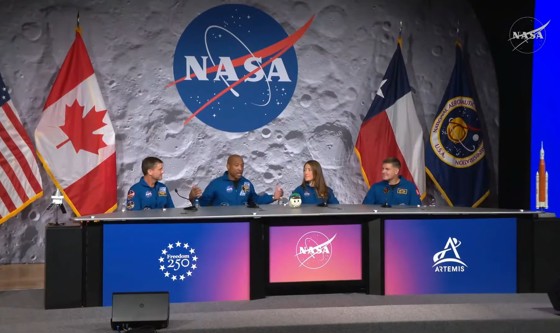
“When we came home, we were shocked at the global outpouring of support, of pride, of ownership of this mission,” said the mission commander, astronaut Reid Wiseman, at a press conference from the NASA Johnson Space Center in Houston, Texas.
“That’s what the four of us wanted. We wanted to go out and try to do something that would bring the world together,” he added, surrounded by his three space travel companions.

The four crew members of Artemis II (Wiseman, Christina Koch, and Victor Glover, from NASA, and Jeremy Hansen, from the Canadian Space Agency) recalled the most notable parts of their expedition on Thursday, which made them the first humans since 1972 to orbit the Moon.
However, several of them admitted that they are still having difficulty processing what they experienced during the ten-day mission, which ended Friday with a splashdown in the Pacific Ocean.

Still floating
Glover stated that he has been “trying to live in a little hole for one week. Been off social media, not on the news” since returning to Earth, while Koch confessed that she still thinks she is floating in space when she wakes up.
Readjustment usually lasts 45 days, according to Glover, a process he explained is identical to what astronauts returning from the International Space Station experience.
The astronaut also recalled one of the moments of greatest adrenaline: the re-entry into the atmosphere, which lasted almost fourteen minutes and reached speeds close to 40,000 kilometers per hour during free fall.

Glover described the moment the drogue parachutes deployed, the pilot parachutes fired, and the main parachutes emerged as feeling like “you dove off a skyscraper backwards,” a sensation that lasted about five seconds.
Hansen, meanwhile, is the only one who will experience this readjustment stage for the first time, as Artemis II was his first experience in space. The Canadian emphasized that the mission went very well thanks to the close trust between the crew and the NASA control center on Earth.
Artemis II aimed to boost the next missions of the Artemis Program, which seeks to land on the Moon twice in 2028, while the US space agency simultaneously advances plans to build a base on the Moon.

“It’s important for us to run these processes out because we are still making changes and learning ways that we’re going to support the 30 and 45-day missions of Artemis II, IV, V. And so it’s really important for us to keep practicing, keeping our heads in the game,” Wiseman explained.
One of the main challenges of the mission was the reliability of the heat shield, a key component for re-entry into the Earth’s atmosphere that suffered more damage than expected during Artemis I, but which the astronauts said was resolved on this occasion.
Wiseman hailed the experts for figuring out the problem and asserted that “it was a smooth ride.” EFE
hbc/dmv/mcd