




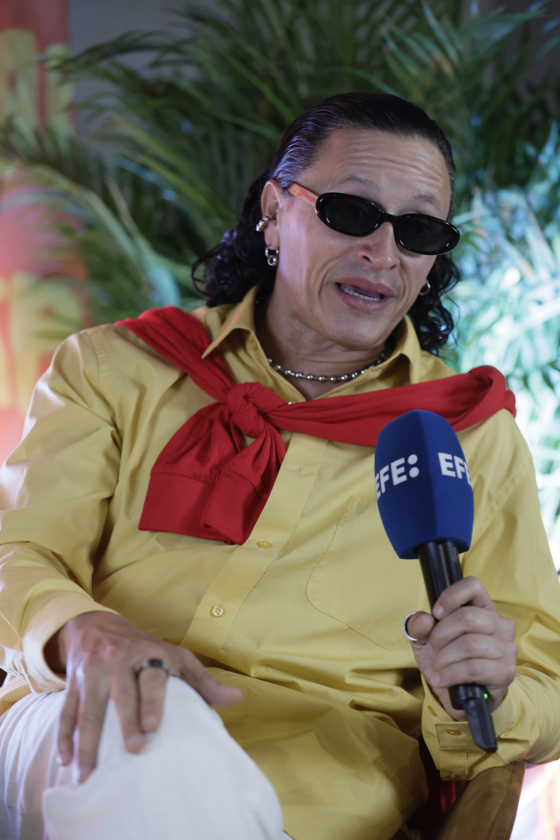
Elvis Crespo, between ‘La graciosa’ and ‘Pa bailar’: “I’m living a magical moment”.
Bogotá, September 18 (EFE)
Elvis Crespo got seasick on the boat that took him to the Canary Island of La Graciosa to film the music video for the song that has topped the charts in Spain all summer. But once ashore, he was convinced that this collaboration with Quevedo would be a success.
“I’m living a magical moment, this summer has been incredible. I never dreamed that a song with a contemporary artist would have the success that ‘La Graciosa’ is having,” the artist says in an interview with EFE in Bogotá on the occasion of the release this Friday of ‘Pa Bailar’, a new song with the Colombian Beéle.

The success of ‘La graciosa’, which is part of Quevedo’s album ‘El Baifo’ and accompanied the Spanish national football team during the summer, coincided with Crespo’s return to Spanish stages, where in July he presented his ‘Poeta Herío’ tour with performances in Jerez de la Frontera, Marbella and Madrid, among other cities.
The Puerto Rican, who filled dance floors with ‘Suavemente’ more than 25 years ago, repeated history from a more mature perspective, and now says he wakes up at 4 a.m. daily to go for a run and music has become, more than a job, a source of fun.

He was born in New York but at 18 he moved to Miami, a starting point and a catapult for his career because it gave him the opportunity, over the years, to record with artists such as Fito Blanco, Steve Aoki or Daddy Yankee.
Evolution of merengue
Its genre is merengue, but its understanding has changed over time: Crespo believes that the key to its relevance lies in its ability to adapt to other sounds and connect with artists of new generations, without losing its tropical essence.
“I realized that my voice is a merengue voice, it’s naturally tropical. It’s my nature, but it adapts to other sounds, to other trends (…) merengue has that magic, that flexibility,” she explains.

For the singer, this ability to fuse allows merengue to dialogue with genres such as reggaeton and urban pop, an evolution that is now exemplified by the new ‘Pa’ Bailar’.
The meeting with Beéle took place in Bogotá, when Crespo first heard the song that the Colombian artist wanted to include on his album. The Puerto Rican accepted the proposal, and the two ended up recording the track after a connection that, as he recalls, was immediate.
“We clicked like that. He’s a natural artist. (…) I saw him as a nephew, as very talented. We clicked creatively right away. Because that doesn’t happen all the time,” he says.

For Crespo, that affinity is one of the elements that makes a collaboration work. It’s not just about bringing together artists from different generations, but about finding a connection that allows the music to flow naturally.
The pressure of ‘Softly’
The success of ‘Suavemente’, which marked his career more than two decades ago, also taught him to let go of the need to compete with his own history.
Crespo acknowledges that for a while he tried to surpass that song, until he understood that he should concentrate on his evolution as an artist and not on repeating a phenomenon that transcended generations.

“Now what I do is have fun. I don’t focus on the numbers. If the numbers come in, great, if they don’t, I can’t let them affect my happiness, my spirituality, and my peace of mind,” he insists.
The singer says this perspective has allowed him to work with greater freedom and explore other genres without losing his identity. His inspiration is the painter Pablo Picasso, who continued creating until the end of his life, an idea he identifies with when imagining his own musical future.
“Pressure can’t be part of my creative process because it can have an impact; you can lose focus thinking about the pressure of your ego. No, I focus on making good music and having fun,” he concludes.