



The cry for help in a devastated city in Venezuela awaiting rescuers.
Catia La Mar (Venezuela), June 25 (EFE)
“Don’t go, don’t leave me,” pleads Amir, a 16-year-old boy who has an entire building pinned down on top of him after the 7.5 and 7.2 magnitude earthquakes in Venezuela.
He has been trapped for more than twelve hours in the rubble of the Luisa Cáceres de Arismendi complex in Playa Grande, in the town of Catia La Mar, in the coastal state of La Guaira, but his face and part of his torso are visible among the debris.

This coastal state in the north of the country, bordering Caracas, is the hardest hit by the earthquakes, according to acting president Delcy Rodríguez, who declared it a “natural disaster zone due to the number of buildings that collapsed.”
Help has not yet arrived where Amir is, and the young man’s strength is waning.

“I think I’m going to be disabled. The building keeps getting heavier,” the teenager, a high school and music student, told EFE.
He was with his father when the earthquake began, and he hasn’t heard from him since.
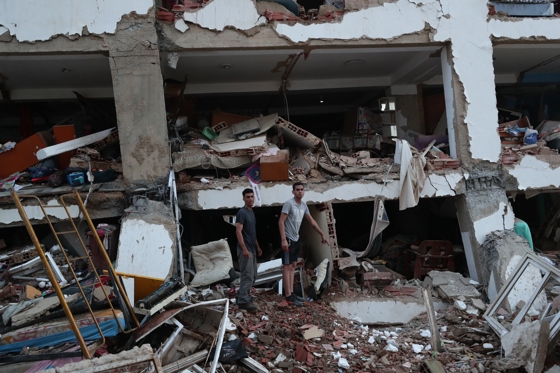
Playa Grande and much of La Guaira are almost without rescue personnel. Firefighters are scarce, and residents say that at dawn this Thursday, no one has come to help them.

Amid tears, residents search for relatives in the rubble.
It’s an essentially human team that, they say, has not yet received support from rescuers, much less machinery to remove debris.
“Help” or “assistance” is the cry heard from the remains of collapsed buildings or those partially supported by weak columns.
These are towers with a privileged view of the Caribbean Sea that are now experiencing a tragedy.
And amid the sound of car alarms mingling with the birds at dawn, someone shouts “Help!”
A neighbor asks, “Where are you? What’s your name?”
The person replies, “First floor.” They have been there for almost 12 hours since the two earthquakes struck on Wednesday.
“Help me, please,” she cries again. Beside her lies the body of a woman.

Another group is searching for someone named Jesús, but 200 meters away, they are trying to find an 11-year-old girl in a housing complex named Hugo Chávez in honor of the president who died in 2013.
The girl’s mother cries desperately as she points out to the people trying to rescue her where Dana might be.
In a country unprepared for an earthquake of this magnitude, security officials and civilians are trying to find the best way to remove rubble using improvised engineering.

The desperation is such that in another building, a group of relatives of a woman named Eva, weeping, say they are willing to move the debris themselves.
“Eva, Eva, Eva,” they shout insistently as they hug each other for strength.
As morning approaches, helicopters can be seen in the sky above a region known until 2019 as Vargas, where thousands died in 1999 amidst floods and landslides that still leave their mark.