




Colombia’s Baby Lemur!
Cali, Colombia (EFE).-
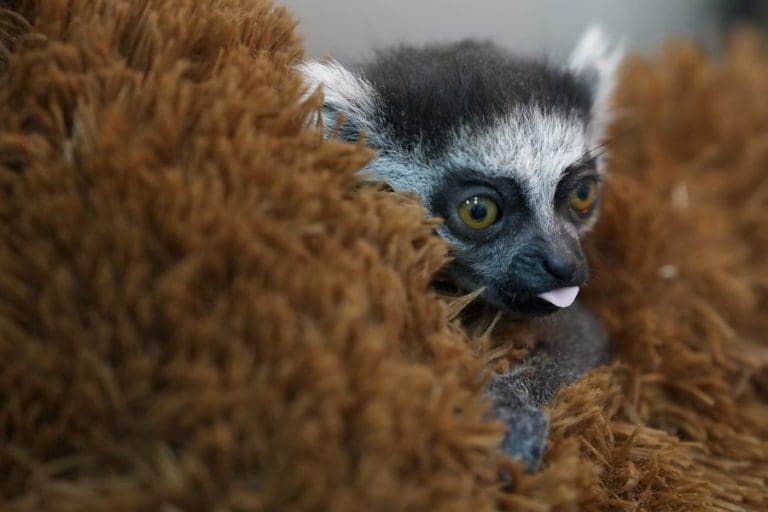
Weighing just 88 grams and clinging to a small stuffed toy that provides the warmth of a mother, a ring-tailed lemur infant is fighting to survive at the Cali Zoo in southwestern Colombia.

A team of specialists has been caring for the baby lemur 24/7 since realizing that shortly after birth the mother was not maintaining constant contact or feeding it enough to ensure its survival.
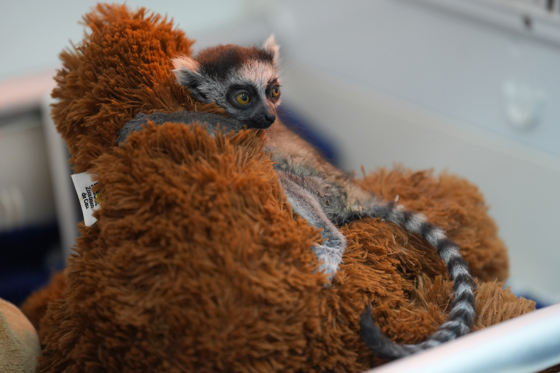
Born on June 18th weighing 70 grams, the lemur’s odds of survival were initially slim. However, after weeks of dedicated care, it is now developing well, thanks to a protocol that includes feeding every two hours, temperature regulation, and stimulation of species-specific behaviors.

“We noticed that the mother was having periods of separation from the infant, which is not normal. We saw that its life could be in danger, so we initiated professional assisted rearing,” explained Camilo Mendoza, the veterinarian and coordinator of Preventive Medicine at the Cali Zoo.
The specialist noted that such situations also occur in the wild, where survival rates are very low. However, thanks to the zoo staff’s intervention, they have been able to “provide care that significantly increases its chances of thriving.”

Specialists in animal care As part of the treatment, the baby lemur receives a specialized formula every two hours, even throughout the night, and has recently begun eating organic vegetable purees.
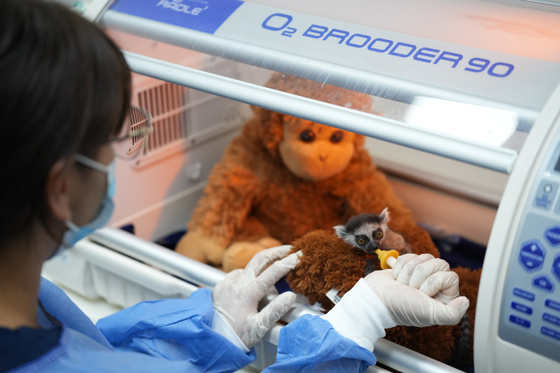
Additionally, the lemur remains in an incubator to maintain body temperature and undergoes grooming sessions with special brushes that mimic maternal care, stimulating basic bodily functions like digestion.

“This care requires a lot of hard work from the team because it needs constant monitoring. Grooming with brushes helps stimulate basic behaviors, such as defecation, since in primates, it is usually the parents who induce these processes,” Mendoza explained.
A plush toy as “mother”
One of the biggest challenges is preventing the animal from becoming accustomed to human contact. During feedings, the lemur clings to a stuffed animal that simulates its mother’s body, while caregivers use gloves and masks to minimize direct interaction.

“Once it completes its initial development, it will begin an environmental enrichment process with branches and structures for climbing before starting a gradual introduction to the rest of the troop,” Mendoza added.
The ring-tailed lemur, endemic to Madagascar, is listed by the International Union for Conservation of Nature (IUCN) as an Endangered species due to habitat loss, deforestation, hunting, and illegal wildlife trafficking.
“Today, at the Cali Zoo, we house seven ring-tailed lemurs and two black-and-white ruffed lemurs as part of our conservation, research, and animal welfare programs. That this little one is alive is a great gift to the entire world,” the veterinarian concluded.
mba/dmv/mcd