


Indigenous seed bank fights hunger in southwestern Colombia
Cumbal, Colombia, (EFE).
At more than 3,000 meters above sea level, an Indigenous community in southwestern Colombia is fighting hunger with a clear goal: preserving ancestral seeds that have sustained generations.

“Recovering the seeds is recovering the territory,” said Segundo Gilberto Peregüez, a member of the Gran Cumbal Indigenous reservation. “Today, Cumbal is a powerhouse in milk production, but soon we will also be a powerhouse in healthy, ancestral food.”
Located in the mountains of Nariño, near the border with Ecuador, the region has seen cattle ranching expand into lands traditionally used for crops. The shift toward dairy production transformed the local economy but endangered food security for thousands of families.

“About 50 years ago, our elders focused on growing food and bartering. Money didn’t matter, food did,” Peregüez recalled. “Today, communities produce milk instead. Crops and traditions have been pushed aside.”
The COVID-19 pandemic exposed that vulnerability. “People had land and cows, but nothing to put in the pot during lockdowns,” the 78-year-old said.

Rediscovering lost seeds
Concerned about the growing dependence on dairy production, teachers at the Indigenous Agricultural Technical School asked students to bring any seeds their families kept at home. The idea was to create a seed bank to cultivate, preserve, and redistribute traditional varieties.
“The response was surprising,” said Esteban Gargotena Rosero, one of the teachers. “We found dozens of varieties of potatoes, beans, corn, and other tubers. That’s when we realized how important it was to keep these seeds alive and return them to households.”

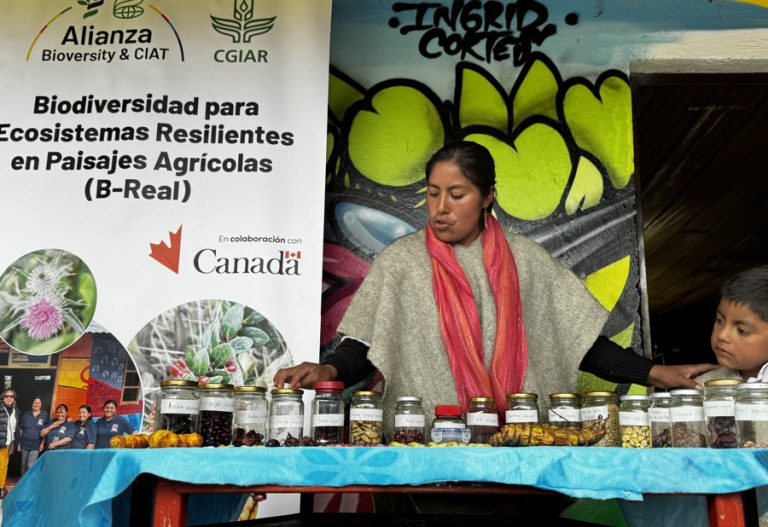
The initiative eventually joined the Biodiversity for Resilient Ecosystems in Agricultural Landscapes program, funded by the Canadian government and led by the Alliance of Bioversity International and the International Center for Tropical Agriculture (CIAT).
The program supports community seed banks to preserve native crops.
So far, the project has identified more than 30 species of food crops and vegetables, 30 species of fruit trees, and around 100 aromatic and medicinal plants.

Teachers and researchers also rediscovered varieties that were believed to have disappeared.
These are now being revived through school gardens, conservation contests, and culinary workshops.
“The process has been very positive. The kids have embraced this knowledge and taken it home. They’re helping protect the seeds and shift mindsets within their families,” said Ronnie Vernooy, senior agrobiodiversity scientist at the Bioversity–CIAT alliance.

A seed bank for the entire territory
To distribute these seeds across different villages, the school created the Yar Pue Cumbe Seed House, the main conversation center that supports nine smaller “nodal banks” in rural schools.
“Families can borrow a kilo of seeds and commit to returning a kilo and a half after the harvest,” explained Jorge Alirio Asa Arellano, a teacher at the Romerillo school. “Meanwhile, children learn how to plant, care for, and cultivate these crops so knowledge survives across generations.”

Recovering traditional crops has brought diversity back to household meals, reviving dishes made with potatoes, beans, quinoa, barley, wheat, “ollucos” (Andean tubers), corn, plantains, and tomate de árbol (tamarillo fruit or tree tomato).
Traditional cooks are once again using ingredients that were vanishing from local kitchens.
“We’ve recovered the flavors our grandmothers left us,” said María Rosero, a traditional cook from Nariño. “Now we prepare dishes with colorful potatoes, with delicious flavors and textures. Seeds on our plates strengthen our food security.”