




Europe rewards the architectural and heritage rescue.
Valencia (Spain), May 26 (EFE)
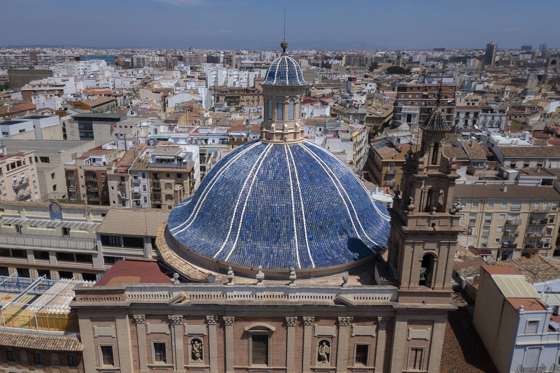
More than 35,000 tiles, scaffolding designed to avoid touching the original structure, and work at a height of more than 40 meters have succeeded in restoring one of the largest domes in Spain, a complex intervention that now receives the honors of the highest European award in architectural heritage conservation.
For two years, restorers, architects, artisans and specialists in historical conservation have undertaken the enormous task of recovering the dome of the Piarist Schools of Valencia (eastern Spain), the second largest in Spain with almost 25 meters in diameter and an area of one thousand square meters.

Built in the 18th century, the dome had significant cracks, water leaks, and serious humidity problems accumulated over decades.
This is explained to EFE by Mairena Velasco and Inés Cámara, executive director and commercial director, respectively, of the company Estudio Métodos de la Restauración (EMR), in charge of carrying out these works in the heart of the city’s historic center.
The restoration project, developed between 2018 and 2025 and directed by the architect Luis Cortés, has been recognized with the aforementioned European award, in which a total of 30 restoration projects from 18 countries across the continent have been distinguished, and the award ceremony will take place next Thursday in Nicosia (Cyprus).

The Piarist Schools building in Valencia was designed by Archbishop Andrés Mayoral in 1768 with the intention that it would stand out in the city and be visible from all points, hence “the grandeur of the church,” explains Francisco Alemany, head of the school, to EFE.
Although this building has three floors, Archbishop Mayoral wanted one more floor, as well as being able to paint the interior of the dome with frescoes by José Segrelles, but the death of the clergyman put an end to the financing of the work.
More than 35,000 roof tiles
One of the most spectacular tasks in the restoration, Velasco points out, was the dismantling and subsequent reinstallation of the ceramic roof, since the dome has a surface area of about 1,000 square meters and more than 35,000 tiles, of which nearly 7,000 had to be replaced, and for this purpose new ones were manufactured by hand in Valencia.
These new glazed tiles were made in different shades of blue to visually integrate them with the originals and avoid excessive contrasts, while many of the old pieces were also manually restored ‘in situ’ by specialists who touched up enamels and imperfections one by one.

For this intervention, traditional techniques have been chosen, so the entire project has been carried out using lime mortars, which are much more compatible with historical materials than the modern cements used in restorations of past decades.
Changes in the work
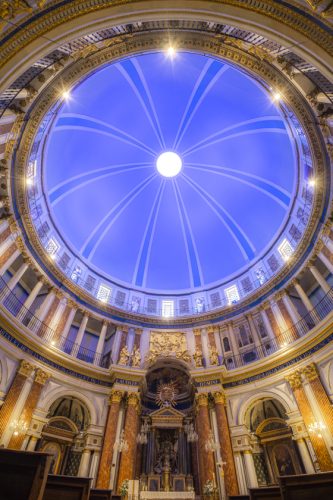
The intervention took a turn when technicians accessed the interior of the dome to work on the cracks from within. There they discovered that moisture accumulated over years had seriously deteriorated the structural ribs near the lantern, to the point of creating a risk of collapse.

The situation necessitated a revised project to also reinforce the interior. A large scaffolding tower had to be erected inside the church to access the damaged areas, some located more than 40 meters high.
“When you went up there, the humidity and heat were unbearable,” Velasco recalls.
This project adds to other work carried out by this company on historical monuments throughout Spain, from the Sagrada Familia in Barcelona to the Cathedral of Santiago de Compostela, including walls, castles and historical aqueducts.