




Costa Rica’s Verbal Conflict!
Costa Rica
San José, Jul 31 (EFE).-
An unprecedented conflict between the Executive and Judicial branches is growing daily in Costa Rica, a country historically characterized by political and social stability, which has recently suffered the impact of violence caused by the rise of drug trafficking and organized crime.

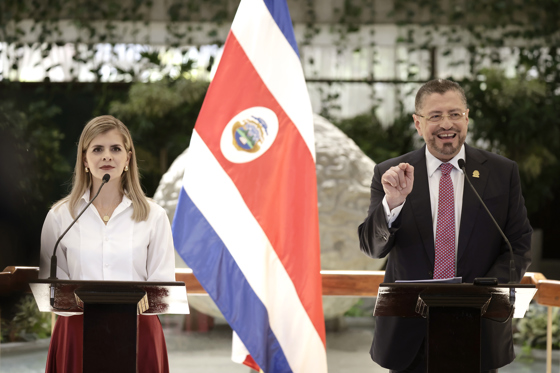
Since right-wing President Rodrigo Chaves took office in 2022, relations between the state branches have shifted due to his constant criticism of the Judiciary, a narrative maintained by his successor, Laura Fernández, who describes herself as his “heir.”
Fernández has criticized judicial salaries and the lengthy terms of magistrates, urging the longest-serving members to make room for others, arguing that the Judiciary fails to fulfill its duty to guarantee prompt and effective justice.
Opposition figures have accused the ruling Sovereign People’s Party of having authoritarian leanings and seeking to control the Judiciary.
Here are the key points to understand this escalating conflict:
1. The constitutional chamber: a focal point of conflict
Fernández accused on Friday the magistrates of the Constitutional Chamber of staging a “coup” by extending the terms of substitute judges, following seven months in which the ruling party in Congress refused to vote on the list of candidates proposed by the Judiciary.

“The coup-plotting magistrates have established a regime where they grant themselves powers that neither the Political Constitution nor international instruments have given to the Constitutional Chamber,” stated Fernández, insisting that only Congress has the authority to appoint magistrates.
The government announced it will file a complaint for official misconduct (prevaricato) with the Supreme Court.

The Constitutional Chamber, responsible for resolving appeals for protection, habeas corpus, unconstitutionality actions, and human rights protection, has been a source of discord due to various rulings against the government, several of which involved violations of press and freedom of expression.
2. Budget cuts and friction with the public prosecutor’s office
Former President Chaves’ criticisms of the Judiciary, which he often refers to as the “Perjudicial Power,” have continued now that he serves as Minister of the Presidency and Finance in Fernández’s government. She has even announced a 5% cut to the judicial budget for 2027, arguing that this will apply to all state institutions.

In early 2025, Chaves led a march demanding the resignation of Attorney General Carlo Díaz, whom he labeled a “thug.”
Díaz leads a series of investigations against Chaves and several of his former government colleagues. Many of them, including the former president, retain immunity in Fernández’s current administration as ministers or deputies.
The most prominent investigations involve alleged illegal financing of Chaves’ campaign and the apparent irregular use of public resources from the Central American Bank for Economic Integration (BCIE).

3. Organized crime strikes amidst disputes between state branches
In recent years, Costa Rica has suffered an escalation in violence attributed to organized crime and drug trafficking, with unprecedented homicide numbers raising the rate to nearly 16 per 100,000 inhabitants.
The capture on July 24 of Alejandro Arias Monge, alias ‘Diablo’, the country’s most wanted drug trafficker, also sparked further controversy.
President Fernández questioned the information provided by the Judiciary and the reason why ‘Diablo’ was transported from prison to a court for his precautionary measures hearing, rather than holding the proceeding virtually.

The Public Prosecutor’s Office lamented that “instead of supporting the work of the institutions tasked with investigating and prosecuting organized crime, speculation is being promoted that only generates disinformation, public distrust, and unnecessary institutional strain.” EFE
dmm/dmv/mcd
