



Caves to escape the heat!
Caves
Rome, Jul 10 (EFE).- By Gonzalo Sánchez
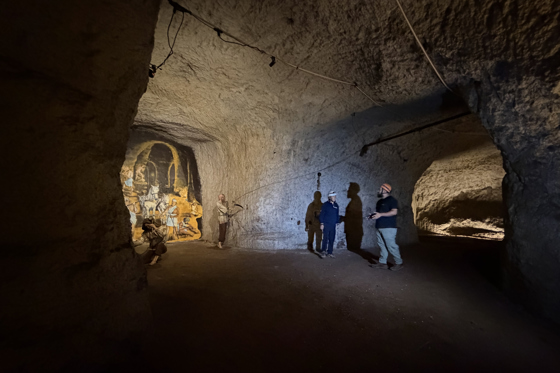
Will humans one day return to caves to escape rising temperatures? It may sound like the premise of a dystopian novel, but Rome is already exploring whether some of its underground caverns could be converted into “climate shelters” where residents can escape extreme heat — provided they first pass rigorous safety and health assessments.

“We want to study the issue of underground spaces very carefully,” Edoardo Zanchini, director of Rome City Hall’s Climate Office, told EFE, stressing that the proposal is a long-term project requiring extensive analysis.
Monument-filled Rome sits atop an extensive network of underground quarries excavated over centuries to extract the stone used to build much of the city.
The subterranean maze also includes early Christian catacombs, more modern railway tunnels and air raid shelters built during the wars that brought bombing to the Italian capital.
Now, some experts see this underground world as a potential tool for adapting to climate change and the increasingly frequent extreme heat waves affecting the Eternal City.
Italy’s Higher Institute for Environmental Protection and Research (ISPRA) has spent years mapping Rome’s underground network as part of a national database designed to improve understanding of these spaces.
The findings could help city officials determine whether some caves can be converted into underground climate shelters — shaded public areas where residents could find relief on the hottest days.

The need is becoming increasingly urgent. Official data show Rome’s average temperature reached 19.7 degrees Celsius (67.5 degrees Fahrenheit) in 2024, 2.5 degrees Celsius (4.5 degrees Fahrenheit) above the average recorded between 1991 and 2020.
The city responded this summer by unveiling its first Heat Plan, which includes a map identifying hundreds of outdoor climate shelters.
Officials are now considering underground alternatives, drawing inspiration from an existing example: the Caffarella Labyrinth, an ancient quarry where the Romans extracted pozzolana, the volcanic ash used to make their famous concrete.
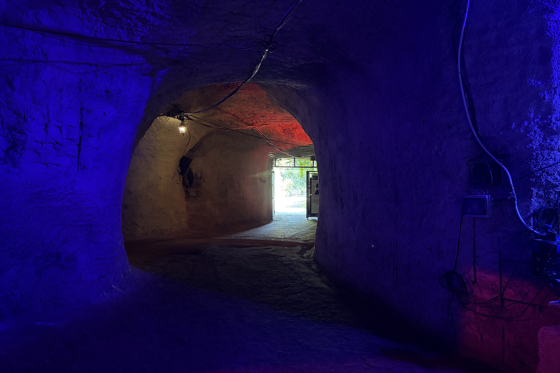
Located in the Appia Antica Regional Park, the cave announces itself to visitors before they even enter. A stream of cool air flows continuously from its entrance, offering welcome relief on summer days when temperatures exceed 30 degrees Celsius (86 degrees Fahrenheit).
Inside, the temperature remains a constant 15 degrees Celsius (59 degrees Fahrenheit) year-round.
“Many people come here seeking relief from the heat at this time of year,” said Alessandro Placidi, the cave’s caretaker and a guide with the Roma Sotterranea Association.
The Caffarella Labyrinth now hosts guided tours exploring its history as a quarry, mushroom farm and wartime shelter. It is also rented out for parties and live-action role-playing events.

Turning underground spaces into public climate shelters, however, will neither be simple nor immediate, according to ISPRA geologist Giuseppe Delmonaco, who accompanied EFE through the cave while putting on a jacket shortly after entering the chilly interior.
The greatest concern is air quality. Poorly ventilated underground spaces can contain elevated concentrations of carbon dioxide or radon, an odorless radioactive gas that is the second-leading cause of lung cancer after smoking.
Delmonaco said thorough studies of both air quality and geological stability would be essential before opening such sites to the public, as structural collapses also pose a potential hazard.

ISPRA plans to launch a project in cities including Rome that will install monitoring systems to provide public authorities with continuous data.
“Our project aims to create a technological infrastructure that establishes the minimum conditions needed for these underground spaces to be safely used,” Delmonaco said.
Zanchini agreed that safety must come first and cautioned that the process will take time.
“First, we have the responsibility to carry out a number of inspections,” he said.
The city is considering not only Rome’s natural caves but also other underground spaces, including dictator Benito Mussolini’s bunker. The key, Zanchini said, is ensuring that any future climate shelters are both safe and free for everyone to use. EFE
aty/lds