


The shadow of violence threatens World Cup!
Sports Desk, Feb 25 (EFE)
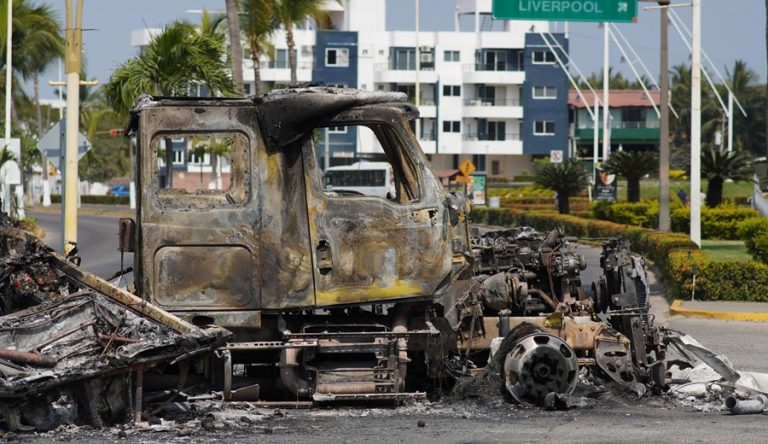
The recent wave of violence unleashed in Mexico after the death of drug kingpin Nemesio Oseguera Cervantes, ‘El Mencho’, has raised doubts about the security of the North American country for the World Cup, which will be held from June 11 to July 19 and is being co-hosted with the United States and Canada.

Although Mexican President Claudia Sheinbaum assured on Tuesday that there is “no risk” to the safety of visitors during the World Cup, especially in Guadalajara, the initial focus of events after the death of the top leader of the Jalisco New Generation Cartel (CJNG), the situation in Mexico is under the microscope of all those interested in the global event.
To demonstrate this concern, and coinciding with FIFA’s reported security situation in the country, Bolivia, which will play in the intercontinental play-off in Monterrey in March, will send a letter to the governing body of football asking for increased security measures.

Violence and sporting events
This is not the first time that a complex public order situation has threatened the holding of a sporting event in times of peace or when there have been no major war events such as the two World Wars (1914-1918 and 1939-1945).
In 2001, amid the stormy peace talks between the Government and the FARC guerrillas, Colombia’s status as host country for the Copa América was in doubt after the kidnapping of Hernán Mejía Campuzano, vice president of the Colombian Football Federation and member of the tournament’s organizing committee, just 16 days before the opening day.
Amid the tension generated by this event, Canada and Argentina decided not to participate, citing security reasons, so the Costa Rican and Honduran teams took their places.

Finally, Colombia received the ‘blessing’ of the South American Football Confederation (Conmebol), giving the tournament the name ‘The Peace Cup’, with such good fortune that there was not a single episode of violence due to the truce agreed between the Government and the FARC.
In sporting terms, the tournament was also a success; Colombia won its first and only Copa América, and the improvised Honduran team surprised everyone by achieving third place.
Eighteen years later, the first single-match final of the Copa Libertadores, which was to be played in Santiago, had to be moved to Lima because the violence of the massive protests caused in the context of the social uprising in Chile made it impossible to play the match between Flamengo and River Plate, which Mengao won 2-1.

To Madrid because of the violence
But the last Copa Libertadores final with two-legged matches in 2018 was a different story. River Plate and Boca Juniors were meeting for the first time in a final, and after the 2-2 draw in the first leg at La Bombonera on November 11, the second leg was scheduled to be played at the Monumental in Núñez on the 24th of the same month, but violent fanaticism took its toll.
The bus carrying the Boca delegation to River’s stadium was attacked with stones and bottles by River Plate hooligans, causing Boca to refuse to play the match.
After several days, Conmebol, following negotiations with the Royal Spanish Football Federation and Real Madrid, decided that the final match would be played on December 9 at the Santiago Bernabéu stadium, a match that River won 3-1.

Sport is stained with blood
In America, football is not the only sport chosen by violent individuals; there are also events that have disrupted the normal course of events and even claimed lives.
The most notorious occurred on April 15, 2013, when brothers Tamerlan and Dzhokhar Tsarnaev detonated two explosive devices in the Boylston Street area, while the Boston Marathon was taking place, resulting in 4 deaths and 282 injuries.
Tamerlan was killed by authorities at the scene, while Dzhokhar managed to escape, only to be captured days later while attempting to flee Massachusetts. He was sentenced to death, but his sentence was initially commuted to life imprisonment. On March 4, 2022, the U.S. Supreme Court upheld the death penalty ruling.