




Runoff election October 25th!
Brazil
Sao Paulo, Oct 4 (EFE).- By Manuel Pérez Bella
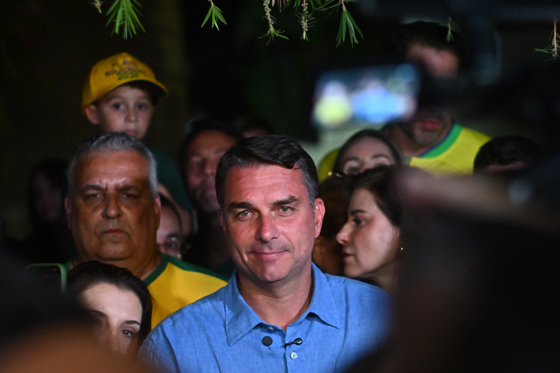
Brazil will hold a runoff presidential election Oct. 25 after opposition candidate Flávio Bolsonaro won 47% of the vote Sunday, compared with 45% for President Luiz Inácio Lula da Silva. The result for the eldest son of former President Jair Bolsonaro, the leader of Brazil’s far right, was a surprise and far exceeded the forecasts of all opinion polls, which had predicted a narrow victory for the leftist president.
Flávio received 56 million votes, 5 million more than his father received in the first round in 2022.

Lula, meanwhile, lost 4 million votes and saw his support weaken in key regions such as Minas Gerais, the country’s second-largest electoral district and a swing state that historically has been considered essential to winning the presidency.
Sunday’s result was the most polarized first round since Brazil returned to democracy in 1985, with the two leading candidates accounting for 92% of the vote, far ahead of third-place finisher Augusto Cury, a writer and psychiatrist making his political debut who received 2.89%.
The difference between Bolsonaro and Lula was 2.2 million votes.
Heading into the runoff, the 9 million votes distributed among the other candidates are at stake, as is the support of the 21% of voters who abstained, a figure slightly higher than in 2022.

The victory of the 45-year-old candidate of the Liberal Party, or PL, was reflected in legislative and regional elections, in which right-wing parties expanded their power across Brazil’s political map.
In the Senate, the PL doubled its caucus to 28 seats, one-third of the chamber, allowing right-wing legislative proposals to advance and potentially opening the door to efforts to impeach Supreme Court justices, an institution whose image has been tarnished by a major corruption scandal.
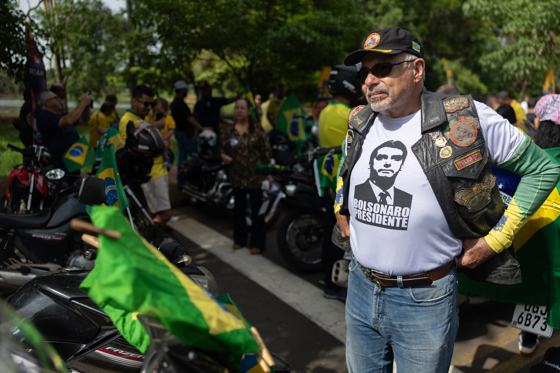
The PL also gained strength in state governments, which enjoy broad autonomy. In São Paulo, Brazil’s most populous state, Bolsonaro ally Tarcísio de Freitas was reelected by a wide margin over Fernando Haddad, a former Lula Cabinet minister who entered the race at the president’s urging.
After the results were announced, a smiling Flávio Bolsonaro said the only way to interpret the first round was that “Brazil wants change.”
“The word is change. Brazil can’t take it anymore,” Bolsonaro said, predicting the “end of the era” of the Workers’ Party, or PT, founded by Lula in 1980.

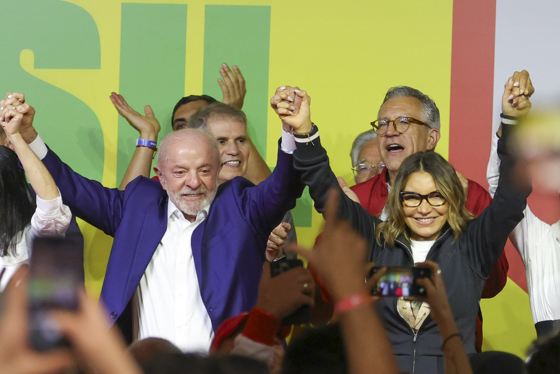
There were fewer smiles at Lula’s campaign headquarters. Lula acknowledged that the result was “unexpected,” but noted that it was not new territory for him because he had been forced into a runoff in all three elections he won, in 2002, 2006 and 2022.
Brazil’s election has become an important arena in President Donald Trump’s dual campaign to promote the advance of right-wing forces in Latin America and contain China’s growing influence in the region.
The reaction from Argentine President Javier Milei was immediate. “Freedom is advancing in Brazil,” the libertarian leader said in congratulating Bolsonaro, whom he personally supported at the launch of his campaign last July.
Milei’s full post also called Flávio Bolsonaro a “dear friend,” described the election as “historic” and said he hoped Argentina and Brazil could work together as major commercial, cultural and political partners.

In recent months, Trump, an ally of the Bolsonaro family, has escalated tensions with the Brazilian government. That has included a series of measures that Lula has interpreted as an attempt to interfere in the election.
Among those measures are the imposition of tariffs, the revocation of the Brazilian ambassador’s visa in Washington and the designation of Brazil’s two largest drug-trafficking organizations as “terrorists,” a decision criticized by Lula and applauded by Bolsonaro, who has made public security one of the main pillars of his campaign.
Sunday, Federal Police Director-General Andrei Rodrigues announced that the agency had opened a preliminary investigation to determine whether the United States had attempted to interfere in the electoral process.

Brazil’s Federal Police confirmed that the investigation followed a request from the attorney general’s office to investigate alleged foreign interference. Rodrigues said the matter had been sent to the agency’s intelligence directorate for investigation.
However, Supreme Electoral Court President Kassio Nunes Marques said that “so far” there was “no concrete indication” of international interference in any of the rooms or teams used during the electoral process.

That wording closely matches Nunes Marques’ statement during a news conference: “Until now, we have no concrete indication of international interference.” He also said the court had received no reports from the Federal Police or intelligence agency indicating such a risk. EFE
mp/lds
