





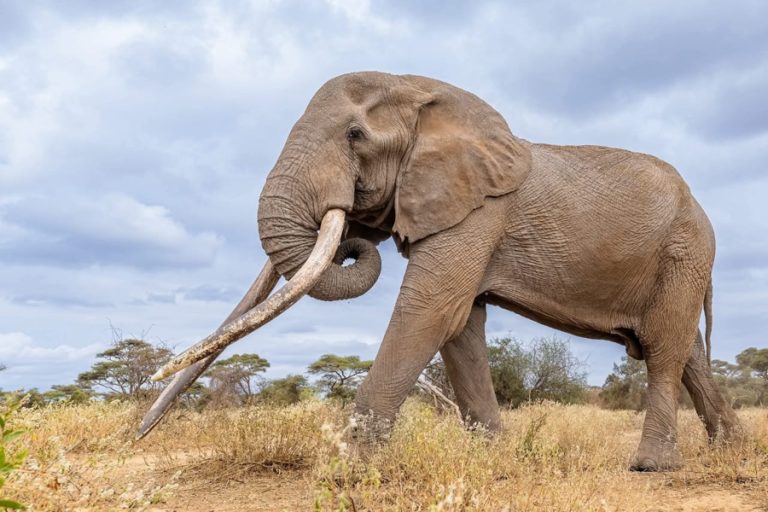
Craig “Super Tuskers” dies in Kenya!
Nairobi, Jan 3 (EFE).-
Craig, one of Africa’s last remaining “super tuskers” died early Saturday at the age of 54 in Kenya’s Amboseli National Park, the Kenya Wildlife Service (KWS) said.

“Beyond his extraordinary tusks, Craig was beloved for his remarkably calm nature,” KWS said in a statement.
“He seemed aware of his place in the world, often standing patiently as visitors photographed and filmed him.”
Widely documented and admired worldwide, Craig became a symbol of Amboseli and a powerful emblem of successful wildlife conservation, the agency added.

Despite his imposing size, Craig was known for his gentle temperament and allowed people to observe him from unusually close distances.
For years, he was accompanied by a specially assigned ranger tasked with ensuring his safety.
The conservation group Amboseli Trust for Elephants confirmed on social media that Craig died of natural causes.

Born in January 1972 to the matriarch Cassandra, Craig was among the last surviving “super tuskers” in Africa, elephants whose tusks weigh more than 45 kilograms each.
His massive ivory made him a rare sight and a living monument to the continent’s natural heritage.
Craig fathered several calves, helping preserve a genetic line associated with large tusks and calm behavior, KWS said.

His long life, the agency added, was made possible through coordinated conservation efforts involving rangers, scientists, and local communities.
“Continuous monitoring, anti-poaching initiatives, habitat protection, and community engagement ensured that Craig lived freely and safely, demonstrating what collective commitment to conservation can achieve,” KWS said.

Africa’s elephant population has declined by about 60 percent over the past five decades, according to the International Union for Conservation of Nature (IUCN), which lists the species as endangered.
Habitat loss and poaching, driven largely by demand for ivory, particularly in parts of Asia, remain the main threats.

Conservationists believe that many of the world’s remaining super tuskers are found in the Amboseli ecosystem, where unique genetic traits and sustained protection have allowed a small number to survive. EFE

lbg-sk
