



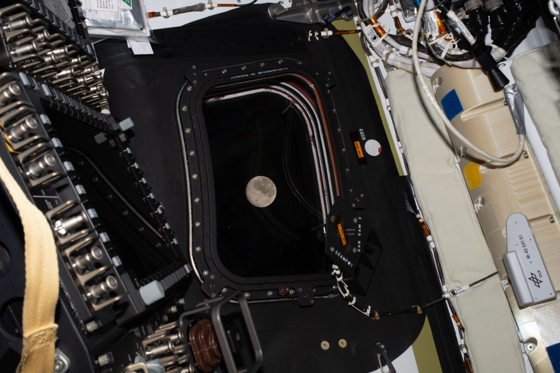
Artemis II faces a 40-minute silence.
Miami (USA), Apr 6 (EFE)
NASA’s Artemis II mission Orion capsule will enter lunar orbit this Monday and will experience one of its most exciting moments during its passage over the far side of the Moon, when it loses communications with Earth for about 40 minutes and is completely isolated in space.
The four astronauts of Artemis II – Reid Wiseman, Christina Koch and Victor Glover, of NASA, and Jeremy Hansen, of the Canadian Space Agency – will be the first human beings to gaze upon the other side of the Moon with their own eyes since the Apollo 17 mission in 1972.

But this milestone will entail a total loss of connections with our planet, since the Moon’s position between the Earth and the spacecraft will block radio signals.
However, NASA has assured that they have it completely under control. Before Artemis II, more than 20 astronauts from the Apollo missions experienced this absolute silence.

A 40-minute silence
NASA expects the spacecraft to pass behind the Moon at around 6:44 p.m. Eastern Time in the United States (10:44 p.m. GMT), and estimates that the loss of communications will last around 40 minutes.
The natural satellite, a solid mass of rock and regolith almost 3,500 kilometers in diameter, prevents radio waves from NASA’s control center or the capsule from meeting, so it will be necessary to wait until Orion appears on the other side of the Moon.
This silence will be unusual for the astronauts, who are in constant contact with NASA experts during the mission, which took off last Wednesday from Cape Canaveral (Florida) and lasts for ten days.

Why there is a ‘hidden’ side
The Moon has a ‘hidden’ side due to synchronous rotation, which means it takes the same amount of time to rotate on its axis as it does to complete an orbit around the Earth.
This causes it to always show the same face to our planet, so its other side is not visible from Earth. Studying this region of the satellite must be done using telescopes, satellites, and lunar missions like Artemis II.
Furthermore, both sides are very different: while the visible side has large plains of basaltic lava called ‘seas’, the hidden side mainly has craters and mountains from the impact of meteorites.

The eyes are the best tool
The Artemis II astronauts will contribute to their research this Monday by taking photographs – the capsule carries 32 cameras and devices – and observing from the windows of Orion.
NASA reported that “human eyes and brains are very sensitive to subtle changes in color, texture, and other surface features,” so they can provide details that escape cameras or other technologies.

“Direct observation of the lunar surface by astronauts, along with all the scientific advances achieved in recent decades, could reveal new discoveries and a deeper appreciation of the characteristics of the lunar surface,” the space agency said in a statement.
The Eastern Basin will be one of the main objects of study for the crew, a 930-kilometer-wide impact crater in the southern hemisphere of the Moon.

A distance record and a solar eclipse
During its passage over the far side, the Orion capsule will be 406,773 kilometers from Earth, the greatest distance ever traveled by a manned mission.
It will surpass the 400,171 kilometers that Apollo 13 reached accidentally in 1970. The mission, which popularized the phrase “Houston, we’ve had a problem,” suffered a technical issue that forced it to circle the Moon without entering its orbit, using its gravity to propel itself back to Earth.
Also on Monday, two hours before passing over the far side of the Sun, astronauts will be able to observe a solar eclipse for about 53 minutes, which will not be visible from Earth. EFE