




Amnesty Law by Delcy Rodríguez!
Caracas, Feb 6 (EFE).-
Venezuela is moving ahead with public consultations on an amnesty law proposed by acting President Delcy Rodríguez, while Parliament promised approval of the legislation and the release of “all” detainees “no later than” Feb. 13.
Parliament Speaker Jorge Rodríguez, a leading figure of the ruling Chavista movement, told relatives of political prisoners in Caracas on Friday that the second debate on the bill will be held Tuesday and added that “between next Tuesday and, at the latest, Friday, they will all be free.”

The legislation cleared the first of two required debates on Thursday.
Once the bill is definitively approved in the second debate, Rodríguez said, “that same day, they all walk free.”
He made the remarks to relatives of political prisoners who for the past month have maintained a permanent vigil outside the detention center known as Zone 7, a Bolivarian National Police command facility in eastern Caracas.
During the visit, Rodríguez was accompanied by Chavista lawmaker Jorge Arreaza. They listened to the families’ accounts and tears as relatives alleged due process violations and a lack of access to medical treatment for political prisoners inside the facility.

Earlier Friday, the parliamentary speaker called for relatives of political prisoners to be included in the public consultation process for the law during a national parliamentary meeting of the ruling United Socialist Party of Venezuela (PSUV).
Arreaza, who chairs the parliamentary commission overseeing the legislation, said on Telegram that the commission — made up of 19 lawmakers — had been formally established and would work “with various sectors” to hear “all proposals.”
As part of the public consultation, Parliament’s Interior Policy Commission met with deans of law schools from 16 universities to review the draft bill. The text was officially published on Parliament’s Telegram channel at 8:15 p.m. local time Friday (0015 GMT).

The Democratic Unitary Platform (PUD), which groups Venezuela’s main opposition parties, on Friday criticized what it called “serious omissions” and exclusions in the draft law.
In a statement posted on X, the PUD said the text contains “serious omissions,” including the exclusion of “broad groups of civilian and military political prisoners,” as well as periods of “historical significance” not covered by the law.
The opposition alliance also faulted the draft for failing to repeal laws such as the Anti-Hate Law or the Simón Bolívar Law, which it said are part of Venezuela’s “repressive legal framework.”

Former Spanish Prime Minister José Luis Rodríguez Zapatero said the amnesty would mark “a before and an after” for Venezuela, speaking to EFE after arriving in Caracas to take part in dialogue efforts at the invitation of Culture Minister Ernesto Villegas, who coordinates the Program for Democratic Coexistence and Peace.
“I support the amnesty. I want it to be as broad as possible and for the timelines to be fast,” Rodríguez Zapatero said at the Rómulo Gallegos Latin American Studies Center in Caracas.
He also said he trusted that the coexistence program, recently created by the acting president, would have an “open vision” and include victims.

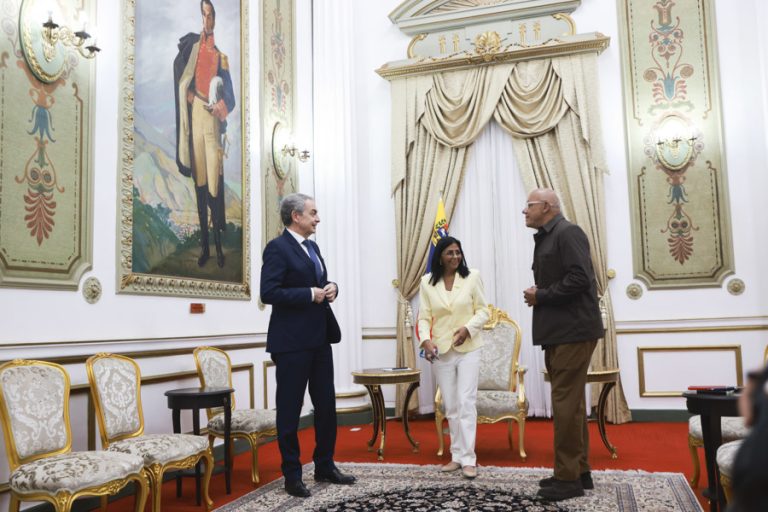
Rodríguez Zapatero later met with the acting president and her brother, the parliamentary speaker, at the Miraflores Palace, the presidential seat in Caracas. Opposition lawmaker Timoteo Zambrano told EFE that Rodríguez Zapatero will return to Spain on Saturday.
The draft bill, which could change before the second parliamentary debate, contains 13 articles and provides amnesty for cases linked to 10 periods of political crisis since 1999, when Chavismo came to power.
Among other provisions, it calls for nullifying cases involving political prisoners and states that investigations will be “terminated” and that “records and criminal histories” will be erased.

It also establishes that a “competent court” will receive applications from detainees or the public prosecutor’s office to review whether each case qualifies for amnesty, including the review of sentences.
The amnesty excludes crimes such as serious human rights violations, crimes against humanity and war crimes.
Rodríguez proposed the amnesty on Jan. 30 amid a gradual process of releases that began Jan. 8, days after Venezuelan President Nicolás Maduro and his wife, lawmaker Cilia Flores, were captured in Caracas by U.S. forces. EFE

ls/lds
