




UN General Assembly’s high-level Talks!
United Nations, Sep 19 (EFE).-
More than 130 world leaders and senior officials are expected in New York for the UN General Assembly’s high-level week, where Donald Trump and Venezuela’s Delcy Rodríguez are set to draw particular attention, while Vladimir Putin and Xi Jinping will again stay away.

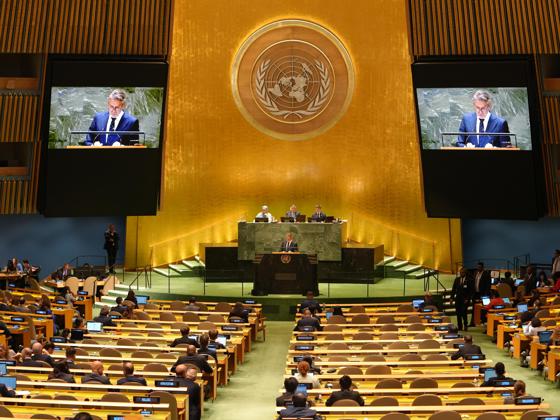
A total of 81 heads of state and 50 heads of government, along with vice presidents and ministers, are expected to participate in the General Assembly’s general debate, which runs from Sep. 22 to 28.
One of the most closely watched appearances will be that of Delcy Rodríguez, the interim president of Venezuela.

If confirmed, it would mark the first visit by a Venezuelan head of state since Nicolás Maduro addressed the assembly in 2018.
Maduro is now being held in a prison just a few kilometers from UN headquarters.
Lula, Trump, Kast and Fujimori open the debate
As tradition dictates, Brazilian President Luiz Inácio Lula da Silva will open the general debate next Tuesday, following addresses by UN Secretary-General António Guterres and General Assembly President Khalilur Rahman.
Trump will speak immediately afterward. Lula has already said he intends to urge the US president not to interfere in Brazil’s presidential election, scheduled for October.

The newly elected presidents of Peru and Chile, Keiko Fujimori and José Antonio Kast, are also expected in New York, alongside the leaders of Ecuador (Daniel Noboa), Argentina (Javier Milei) and Bolivia (Rodrigo Paz), among others.
Colombia’s new president, Abelardo de la Espriella, will not attend and will be represented by Vice President José Manuel Restrepo Abondano.
Mexican President Claudia Sheinbaum will also be absent, with Foreign Minister Roberto Velasco Álvarez leading her country’s delegation.
Cuban Foreign Minister Bruno Rodríguez is expected to address the assembly and denounce what Havana describes as pressure from the Trump administration against the government of President Miguel Díaz-Canel.

Neither Putin nor Xi
The General Assembly’s High-Level Week will once again take place without Vladimir Putin or Xi Jinping.
Russia’s delegation will be led by Foreign Minister Sergey Lavrov, while China will be represented by Vice President Han Zheng.
Xi’s absence has attracted particular attention because he is expected to travel to Washington later the same week for talks with Trump, even though neither he nor Putin has attended the General Assembly in person for more than a decade.

Europe rallies behind Zelenskyy
European leaders are expected to hold a Security Council meeting on the war in Ukraine during the week, demonstrating support for President Volodymyr Zelenskyy, who will also attend the summit.
The meeting comes as Guterres has warned that the conflict continues to escalate.
French President Emmanuel Macron will deliver what is expected to be his final General Assembly address before leaving office in 2027.
The newly appointed prime ministers of the United Kingdom, Andy Burnham, and Hungary, Péter Magyar, will also make their first appearances at the assembly Spain will be represented by Prime Minister Pedro Sánchez. However, German Chancellor Friedrich Merz and Italian Prime Minister Giorgia Meloni are not expected to attend.

Iran present, Abbas absent
The Middle East is expected to dominate much of this year’s debate, one year after several countries recognized the State of Palestine and a majority of UN members endorsed the New York Declaration in support of a two-state solution.
Palestinian Authority President Mahmoud Abbas will again be unable to attend in person after the United States denied him a visa.
Under an agreement approved by the General Assembly, he will instead address delegates via videoconference.
The Trump administration has, however, granted entry to Iran’s delegation, which is expected to be led by President Masud Pezeshkian.

Also scheduled to speak are King Abdullah II of Jordan, Qatar’s Emir Tamim bin Hamad Al Thani, and Rashad al-Alimi, head of Yemen’s internationally recognized government, as regional tensions continue following the U.S.-Iran conflict that began earlier this year. EFE
ecs-sk
