



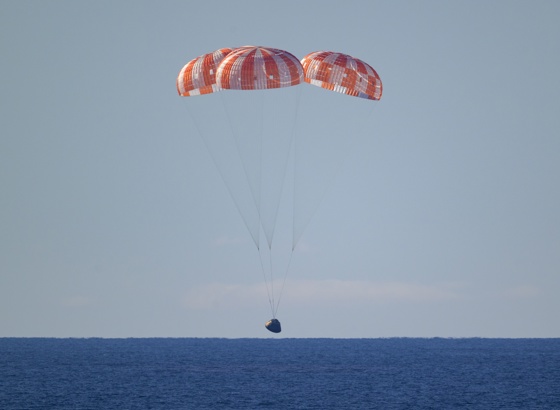
The Artemis II capsule Splashed down in California!
The Artemis II crewed capsule splashed down near the coast of Tijuana, Mexico.
Miami, US, Apr 10 (EFE).-
The Artemis II crewed capsule, which orbited the Moon on a historic mission, splashed down Friday near the coast of San Diego, California, with the help of parachutes to slow its speed during a free fall lasting about 14 minutes after entering Earth’s atmosphere.
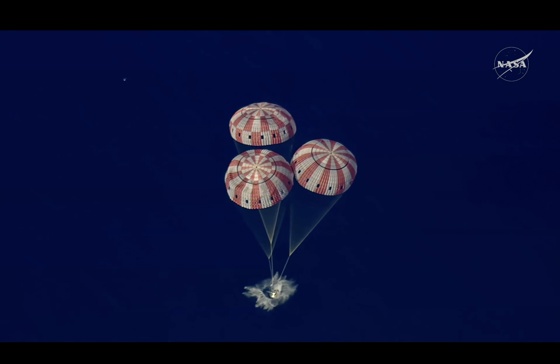
NASA described it as “a perfect bullseye splashdown” and reported in advance that divers are expected to approach Orion to assess the air and water around the spacecraft and ensure it is safe for the crew, Reid Wiseman, Christina Koch, Victor Glover, and Jeremy Hansen, to exit.

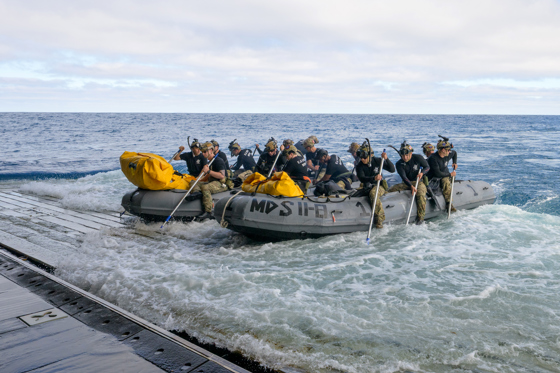
The recovery of the astronauts will be carried out by US military and NASA personnel, and will take between 30 and 45 minutes.
Wiseman reported that all four crew members are in good condition. “We are stable,” he said. “Four green crew members.”

”Congratulations. Artemis II, mission accomplished,” wrote NASA Administrator Jared Isaacman on X.
Artemis II thus concludes a 10-day mission that launched from Florida on April 1, during which it orbited the Moon without landing, marking the first return of astronauts to its vicinity since 1972.

During reentry, the four astronauts endured speeds exceeding 40,000 kilometers per hour (approximately 24,661 miles per hour), while the spacecraft faced extreme temperatures generated by friction with Earth’s atmosphere, reaching nearly 2,760 °C (5,000 °F).
”Reid, Victor, Christina, and Jeremy did an outstanding job. These talented astronauts inspired the world and represented their space agencies and nations as humanity’s ambassadors to the stars,” Isaacman added.
NASA reported that so far, all maneuvers have presented no issues.
The maneuver, which also included a planned six-minute communication blackout following reentry into the atmosphere, was a litmus test to evaluate the heat shield protecting the spacecraft and the astronauts.

Artemis II reentered Earth on a more direct trajectory than that taken by Artemis I, the 2022 uncrewed mission, to reduce the chances of the heat shield sustaining damage that could endanger the four astronauts.
This time, the reentry lasted nearly 14 minutes instead of 20, resulting in a lower thermal load on the shield, according to NASA.
When the astronauts exit the spacecraft, they will be taken to an inflatable platform, where two helicopters will pick them up and transport them to the medical facility on a ship, followed by further medical examinations on land.
Meanwhile, Orion will be towed to the ship for its return to the Kennedy Space Center in Florida, after traveling over 1.1 million kilometers (694,481 miles). EFE
ims/mcd