




Mercosur and the European Union!
Asunción, Jan 18 (EFE).- By Carlos Meneses
After signing a free trade agreement that took 26 years to negotiate, Mercosur and the European Union are moving to expand their commercial ties with Asia and other key global partners as a US trade war reshapes the global context.

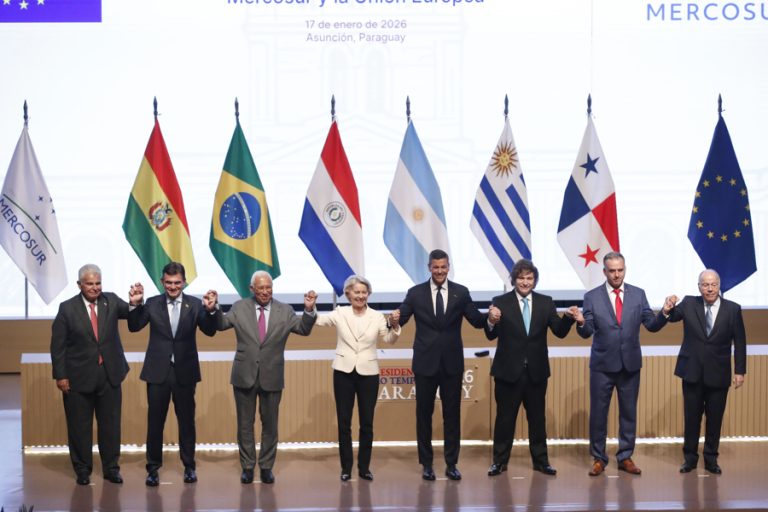
The South American bloc, made up of Argentina, Brazil, Paraguay, and Uruguay, has emerged from years of inertia and, in just two years, has concluded three trade agreements: with Singapore, the European Free Trade Association (EFTA), and the European Union. The agreement with the EU was signed Saturday in Asunción.
Once ratified, the treaty with the 27-member EU will create the world’s largest free trade area, gradually eliminating or reducing 90 percent of tariffs across a market of 720 million people.

Next stop: United Arab Emirates
Mercosur’s trade push does not stop there. The bloc and the United Arab Emirates expect to conclude negotiations on a free trade agreement later this year.
In addition, at Mercosur’s December summit in Foz de Iguazú, Brazil, members announced the launch of negotiations on a tariff preference agreement with Vietnam.
The bloc has also agreed with Japan to strengthen bilateral relations and has set a one-year deadline to expand its tariff preference agreement with India, in force since 2003.

That Mercosur-India agreement currently provides tariff reductions of up to 20% on around 450 product lines, representing just 5 percent of bilateral trade.
“We are looking very closely at an agreement with Japan, South Korea and other Asian countries beyond China, which is a strategic partner for all Latin American countries and Mercosur,” Paraguayan President Santiago Peña told reporters after the EU deal was signed.

Paraguay currently holds Mercosur’s rotating presidency and has the backing of Brazil, the bloc’s largest economy, to continue expanding trade ties.
“We will continue working to open more markets and build new alliances around the world, particularly with Canada, Mexico, Vietnam, Japan and China,” Brazilian President Luiz Inácio Lula da Silva said Friday in a joint statement with European Commission President Ursula von der Leyen in Rio de Janeiro.
Lula played a key role in finalizing the EU pact and has highlighted that Brazil has opened more than 500 new international markets for its products since he returned to office on Jan. 1, 2023.

A shifting global order
This surge in trade negotiations comes amid a broader global realignment, with the United States engaged in trade disputes and territorial ambitions, while China continues to gain ground in strategic sectors such as critical minerals, key to the energy transition, digitalization and defense.
Europe and the so-called Global South are repositioning themselves in an atmosphere of growing mistrust toward the White House and its occupant, Donald Trump.

One of the objectives of the Mercosur-EU agreement, European officials acknowledge, is to reduce dependence on external suppliers of rare earths. European Trade Commissioner Maroš Šefčovič underscored this point in an interview with EFE in Asunción.
“As Europeans, we are paying a very high price for the dependencies we developed over the past 10 to 15 years, and we clearly want to diversify,” the Slovak diplomat said.

EU also eyes Asia
Like Mercosur, the European Union is also intensifying its engagement with Asia. In September, it finalized a free trade agreement with Indonesia and is now focusing on closing a long-negotiated deal with India.
European Commission President Ursula von der Leyen and European Council President António Costa are scheduled to travel to India on Jan. 27 for a high-level summit with Prime Minister Narendra Modi aimed at advancing those talks.

At the signing ceremony in Asunción, Costa made clear that the EU is determined to strengthen its economic security through “the opening of new markets, the diversification of supply chains and the reduction of excessive dependencies.” EFE

cms-sk
