





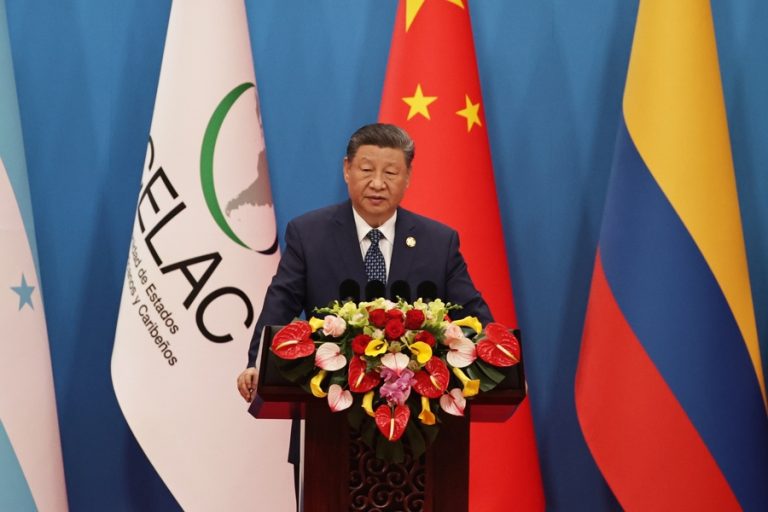
China grows business presence in Latin America!
Shanghai, China, Dec 25 (EFE).-
China has consolidated its presence as the main trading partner of multiple Latin American countries, such as Brazil and Argentina, and has increased its involvement in the region with important projects such as the port of Chancay (Peru), amid further frictions with the United States.
The port, inaugurated last year to directly connect South America and China, joins other initiatives such as vehicle factories in Mexico and Brazil, copper and iron mines in Chile, and other initiatives such as vehicle factories in Mexico and Brazil, railway projects in Argentina and lithium farms in the ‘triangle’ formed by those two countries and Bolivia.

According to the Chinese Ministry of Commerce, the Asian country’s direct investment in Latin America reached $14.71 billion in 2024.
Data from the National Autonomous University of Mexico show that, between 2010 and 2019, this inflow of capital was almost seven times higher than the previous decade, although since the pandemic the pace has slowed.
As early as 2011, Jin Liqun, then president of China Investment Corp – CIC, a sovereign fund with about 1.57 trillion yuan in assets and the task of investing in foreign markets – showed his “optimism” for growth in Latin America and said they would increase their investment in the region, specifically targeting opportunities in countries such as Brazil, Chile and Colombia.

However, what was originally a search for new markets and successful investments is now seen by Washington as a “strategic threat,” according to William Jackson, chief economist for emerging markets at British consultancy Capital Economics.
In a report published this year, the analyst believes that the region could become the stage for a re-edition, this time with China as the protagonist, of the ‘Monroe doctrine’, whereby the US sought to reduce European influence in the American continent in the 19th century.

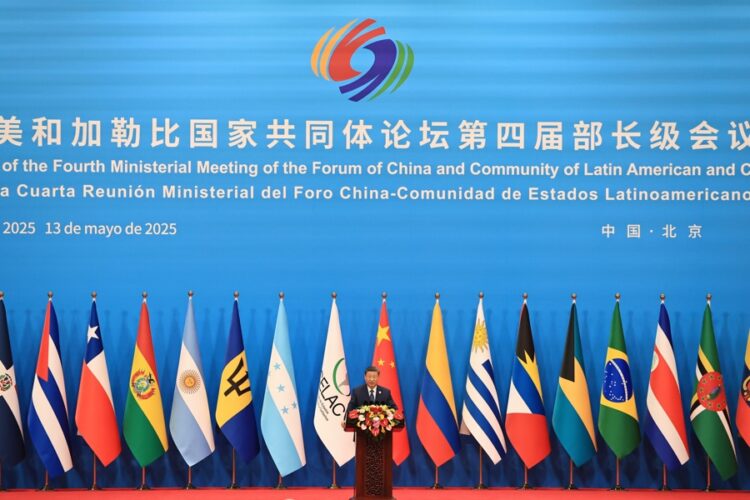
Earlier this month, Beijing released a new official roadmap for Latin America and the Caribbean, the third of its kind since 2008 and a substitute for the 2016 plan, in which it ensures that China and the region share broad development prospects.
The Chinese authorities view opportunities to work with Latin American countries in sectors such as artificial intelligence, telecommunications, renewable energy, hydrogen, mining and mineral processing.

Moreover, the report also mentioned the willingness to promote projects in transport, logistics, housing, electricity and urban development under the umbrella of the Chinese Infrastructure Project for Belt and Road Initiative, to which some 20 countries in the region have joined.
Tourism initiatives are also mentioned – for months, China has exempted visitors from Argentina, Peru or Chile from visas – and an increase in both the use of local currencies in cross-border commercial transactions and the dialogue between regulators and central banks.

Moreover, Latin America is becoming, along with Southeast Asia or Africa, one of the most important alternative markets in which China is pushing foreign trade in the face of the tariff war with the US.
While Chinese exports to the US fell by 18 percent until November this year, those to Latin American countries increased by almost eight percent to some $276 billion, equivalent to 70 percent of what the world’s largest economy buys from the Asian giant.

In the last two decades, said Jackson, Chinese exports to Latin America have multiplied almost 11 times, mainly manufactured goods – and more recently, electric vehicles in markets such as Brazil -, while its imports from the region are 14 times higher, with prominence for four specific products: iron, copper, soybeans and oil.
However, Capital Economics urged not to over-emphasize China’s trade role in Latin America, underlining the region exports three times more to the US than to China. EFE

vec/sc
