




Cempasúchil, the Mexican flower that guides the souls of the dead home!
Atlixco, Mexico, Oct 31 (EFE).-
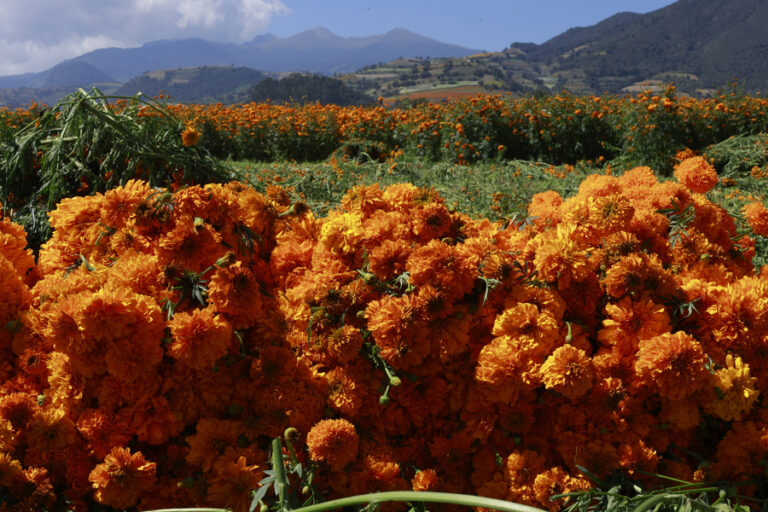
In the central Mexican town of Atlixco, fields of cempasúchil (marigold) burst into vivid shades of orange and gold as producers begin harvesting the blooms ahead of the Day of the Dead celebrations on Nov. 1 and 2.

The flower’s distinctive scent and radiant color are believed to guide the souls of departed loved ones back to their homes, a key element of one of Mexico’s most emblematic traditions.
Workers spend long hours cutting the flowers by hand with curved knives, carefully selecting only the healthiest blooms to decorate altars and offerings honoring the dead.

These “ofrendas” (gifts), which include the favorite foods and belongings of deceased relatives, are central to the Mexican Day of the Dead, a celebration that blends Indigenous roots, Christian faith, and popular creativity.
Once collected, the flowers are sold in local markets, where buyers from across the country negotiate prices before loading truckloads of cempasúchil to be distributed nationwide.
“Across the region, more than 300 hectares of cempasúchil were planted this year, plus about 200 to 250 hectares of terciopelo (velvet flower),” producer Lorenzo Díaz Ortega told EFE. “That means there’s plenty of flowers to sell here in Atlixco, just like every year.”

A tradition that spreads across Mexico
Demand for cempasúchil continues to grow annually, Díaz added, with buyers arriving from all corners of Mexico.
“People come from Michoacán, Guerrero, Oaxaca, Chiapas, Tlaxcala, and one of the biggest buyers is Hidalgo. We’ve also had people come from Sonora, Zacatecas, Colima, Durango, and Quintana Roo,” he said.
According to Puebla’s state authorities, the region leads national production of cempasúchil and terciopelo, accounting for 72% of Mexico’s total output this year.

The flower’s importance extends far beyond economics; it represents a deep spiritual connection between the living and the dead, rooted in pre-Hispanic rituals that honored the afterlife.
A symbol of life, death, and memory
Endemic to Mexico, cempasúchil belongs to a family of about 56 native species and is easily recognized by its round, layered shape and intense fragrance.

Its bright yellow, gold, and orange petals bloom between October and November and have a short lifespan of up to four months.
For many families, placing the flower on their altars is more than tradition; it’s an act of remembrance and love.
As Díaz puts it, the fields of cempasúchil are not just a source of livelihood but a living symbol of a celebration that bridges two worlds. EFE

ggg/seo/mcd
