




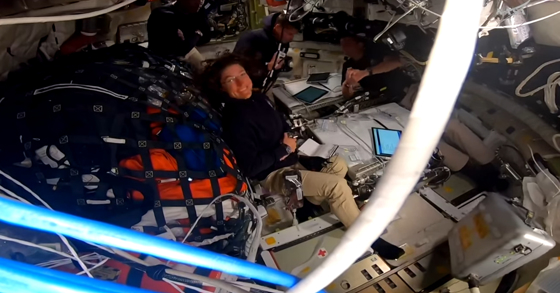
Artemis astronauts orbit the moon!
Astronauts Christina Koch, Victor Glover, Jeremy Hansen, and Reid Wiseman are making history by returning to lunar orbit after more than 50 years.
Miami, US, Apr 6 (EFE).-
The four Artemis II astronauts began observing a 53-minute total solar eclipse from the Orion spacecraft, invisible from Earth, while orbiting the Moon.
NASA had warned that while mission control would temporarily lose communication with the capsule, the Artemis II crew would experience their own solar eclipse.

Astronauts Christina Koch, Victor Glover, Jeremy Hansen, and Reid Wiseman are making history by returning to lunar orbit after more than 50 years.
The crew will be able to observe the eclipse just as Apollo program astronauts did in their time, though not during a flyby like Artemis II’s.
The total solar eclipse, about seven times longer than those seen from Earth, is an opportunity to “analyze the solar corona, the Sun’s outermost atmosphere, while it is visible,” a NASA expert explained to EFE.

She explained that once the Sun is completely hidden behind the Moon, the crew will look for impact flashes (lights produced by meteoroids striking the surface), dust lifted above the Moon’s edge, and deep-space targets, including planets.
After spending approximately 40 minutes in complete silence while flying over the far side of the Moon, a common occurrence on this type of mission, the crew reestablished contact with NASA’s control center in Houston, Texas, at 7:24 pm Eastern Time, according to the space agency’s live broadcast.

Communication between NASA and the crew takes place via the Deep Space Network (DSN) and the Near Space Network (NSN), the primary system used when astronauts are far from Earth.
The latter operates thanks to three complexes of giant antennas located in California, Madrid, and Canberra, enabling a permanent connection.

In addition, the spacecraft is equipped with the Orion Artemis II Optical Communications System, which transmits scientific and crew data via laser, allowing for the transmission of volumes of information 100 times greater than via radio.
Orion began its flyby of the Moon on Monday, scheduled to conclude at 9:20 pm Eastern Time.
The Artemis II mission will exit the Moon’s gravitational influence on Tuesday at 1:25 p.m. Eastern Time as part of its return to Earth.

Artemis II launched on Wednesday from Cape Canaveral, Florida, for a 10-day mission that marked humanity’s return to lunar orbit after half a century.
This is the second mission of the Artemis program, following the 2022 uncrewed flight, and precedes upcoming missions in which astronauts hope to set foot on the Moon in 2028 and establish a permanent presence on the Earth’s natural satellite with a base, as well as laying the groundwork for the exploration of Mars.EFE
ims/mcd