




Venezuela clears Political Prisoners Amnesty Law!
Caracas, Feb 5 (EFE).-
Venezuela’s Parliament, dominated by pro-government lawmakers, took a first step Thursday toward approving an amnesty law proposed by acting President Delcy Rodríguez for political prisoners from the past 27 years of Chavista rule, excluding crimes such as serious human rights violations, crimes against humanity and war crimes.

In the first of two debates required to pass legislation in Venezuela — which coincided with Rodríguez’s first month leading the executive — lawmakers unanimously approved the bill in principle, without publicly detailing its articles.
According to an explanatory memorandum shared with EFE by a lawmaker who requested anonymity, the “Amnesty Law for Democratic Coexistence” contains 13 articles and sets out general provisions “intended to regulate the purpose, objectives and principles of application and interpretation” of the measure.

The bill was formally submitted to Parliament by Jorge Arreaza, a lawmaker and former foreign minister under President Nicolás Maduro, who said the proposal excludes those prosecuted or convicted for serious human rights violations, crimes against humanity, war crimes, intentional homicide, corruption and drug trafficking.
Arreaza, who is also the son-in-law of late President Hugo Chávez (1999–2013), said, “The homeland obliges us to be responsible, to heal wounds, to recognize one another, to understand one another and to jointly build the steps and the paths forward.”
Parliament Speaker Jorge Rodríguez, the acting president’s brother, echoed that message, saying, “We ask for forgiveness, and we must forgive as well. We ask for forgiveness because I say it clearly: I do not like prisoners.”

Rodríguez began his remarks by recalling the history of his father, whom he said was killed by a now-defunct police force during the first government of Carlos Andrés Pérez (1974–1979, 1989–1993). He called for ensuring “that no victim remains unheard.”
He insisted on “the need for healing, the need to bind up wounds, the need to always keep present the early morning of Jan. 3, 2026 — the killing of 120 human beings, the kidnapping of the president.”
Rodríguez was referring to what he described as an attack on Venezuela in the early hours of Jan. 3 by the United States that resulted in the capture of President Nicolás Maduro and his wife, lawmaker Cilia Flores, both of whom he said are now being held in New York.

“Are you going to ask for your prisoners? We are going to ask, for as long as we have life, for our prisoners — for Nicolás Maduro Moros, for our kidnapped Nicolás Maduro Moros and Cilia Flores de Maduro,” he said.
Maduro’s son, lawmaker Nicolás Maduro Guerra, also spoke in defense of his father, saying it was necessary to “row toward” national unity, without “violence, without hatred, without missiles, without military invasion, without kidnappings of presidents.”
Maduro Guerra cited and said he agreed with a remark by opposition lawmaker Luis Augusto Romero: “Venezuela cannot endure one more act of vengeance.”
Opposition lawmakers proposed that the law include guarantees allowing freed political prisoners to rejoin public life without fear of “reprisals.”
Lawmaker Tomás Guanipa, whose brothers Pedro and Juan Pablo — the latter an ally of Nobel Peace Prize winner María Corina Machado — are imprisoned, said the text “must include all guarantees and international standards so that it is a law that applies equally to everyone.”

Guanipa said he hoped the measure would mark “the beginning of a new historical stage” of reconciliation, in which people no longer feel “afraid to say what they think for fear of being arrested.”
Lawmaker David Uzcátegui said the law “must first and foremost contemplate reunion,” with “full freedom for all political prisoners,” as well as “recognition” through “truth spaces so that victims are heard and dignified.”
After the bill’s approval in principle, the acting president welcomed the parliamentary debate, which she described as “elevated,” and emphasized the importance of keeping politics “among Venezuelans.”

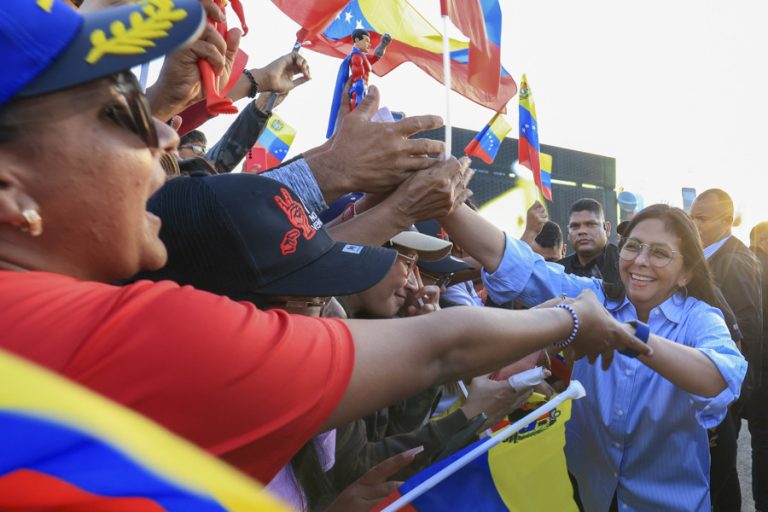
“Reconciliation must involve two sides. Do not miss this opportunity. We are extending our hand, and we hope that with political maturity we will know how to face this new challenge,” Rodríguez said during a coordination event for Peace Quadrants — territorial organizations with security functions — in Bolívar state, in southern Venezuela near the Brazilian border.
The legislative initiative comes amid a process of prisoner releases announced Jan. 8 by Jorge Rodríguez. Since then, at least 383 political prisoners have been released in Venezuela, according to the NGO Foro Penal, which reported that as of Feb. 2 there were 687 political prisoners remaining.
However, Interior and Justice Minister Diosdado Cabello said Monday that 895 detainees have been released since November and denied that political prisoners exist in the country.
Venezuelan law requires that a bill undergo a first discussion to present its rationale and assess its “objectives, scope and viability,” followed by a consultation phase and a second and final debate in which lawmakers review the text article by article. EFE

bam-ls/lds
