





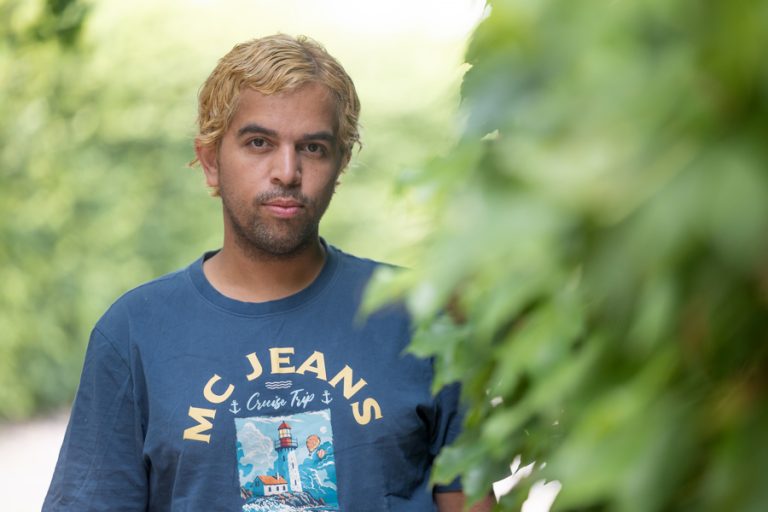
Four months in hell: the testimony of a Brazilian enslaved in Burma.
São Paulo/Buenos Aires, Jan 10 (EFE)
Brazilian Luckas Viana dos Santos was 31 years old when he unknowingly crossed a border that wasn’t mentioned in any contract. He thought he was going to work in customer service in Thailand, but ended up forced to commit online scams and tortured in a rural area of Burma (Myanmar).
Born in São Paulo, Luckas had spent some years moving between countries and trying to make a living from acting, his true passion and the only thing that manages to steal a smile from him during an interview with EFE.

She had worked in Argentina, the Philippines, South Korea, and Thailand, until in mid-2024 a job offer arrived in a Telegram group that caught her attention: it promised about $1,500 a month for customer service tasks.
The contract stipulated six months and a move to Mae Sot, a Thai city on the border with Myanmar.
After several hours on the road, successive vehicle changes and a night crossing in a small boat, Luckas arrived in an armed and guarded territory, where the signs were no longer in Thai, but in Burmese.

He arrived at a complex where he lived with 5,000 other foreigners from all over the world. They confiscated his passport and cell phone, under the promise that he would be able to talk to his loved ones one day a week, which later “did not happen.”
“During the four months I was only able to contact my family four times,” he says.
As he recounts his experience, Luckas’s gaze fixes on a single point, and his pupils twitch, as if he were watching a movie of his own life.
“A horror movie,” he confesses, one he never thought he’d escape. The humiliation of the punishments led him to consider suicide as his only possible way out.

Luckas is the public face of a statistic that continues to grow. In 2024 alone, 63 Brazilians reported being victims of exploitation, most of them in Southeast Asian countries, and the number of victims in 2025 has already surpassed last year’s total, according to sources at the Ministry of Justice.
The business
She learned that the company belonged to some Chinese people who controlled these kinds of clandestine businesses in Burma (Myanmar). Her daily life was transformed into shouts that an interpreter translated into English for her.
He slept in a shared room, ate the same thing every day, “like in a prison,” and during the day he worked about 17 hours in front of a computer.

Their task was to attract clients to invest in online gaming and cryptocurrency platforms.
“The company had a system where we would write and, when we sent the message, it would automatically be translated into the recipient’s language,” he said.
The owners demanded almost impossible results. They had promised him a salary of $700 if he got at least ten people to make deposits. But many “clients” immediately hung up.

Failure to meet objectives had immediate consequences: physical and psychological punishments applied systematically.
The most severe punishments took place in a small room, where thugs beat him with pipes, gave him electric shocks, and slapped him. Other punishments included standing for long periods with water drums on his back or doing push-ups on platforms with spikes.
The idea of escaping began to take shape: he managed to secretly communicate with a friend outside the complex, who contacted an NGO and alerted the television station.

The escape
After three failed escape attempts, followed by punishments, rescue came through the Democratic Karen Buddhist Army (DKBA), an insurgent group that, according to him, opposes this type of activity and managed to negotiate his release and that of several colleagues.
Luckas left “with only the clothes on his back” and his passport in hand.
After that, he decided to move back to Argentina, where he had already built a network of contacts to resume his working life.

Not getting stuck in the past is now their form of resistance.
“Many people judge me and say, ‘She’s traveling, she’s happy.’ But what am I going to do? Am I going to stay inside a room forever? Out of my 32 years, it was four months. I have memories, but I’m not going to dwell on that. I want to move on with my life.”
