




Ecuador and Colombia Tit for Tat!
Bogotá, Jan 22 (EFE).-
Colombia and Ecuador entered into a trade war on Thursday with the mutual imposition of tariffs motivated by the fight against drug trafficking.
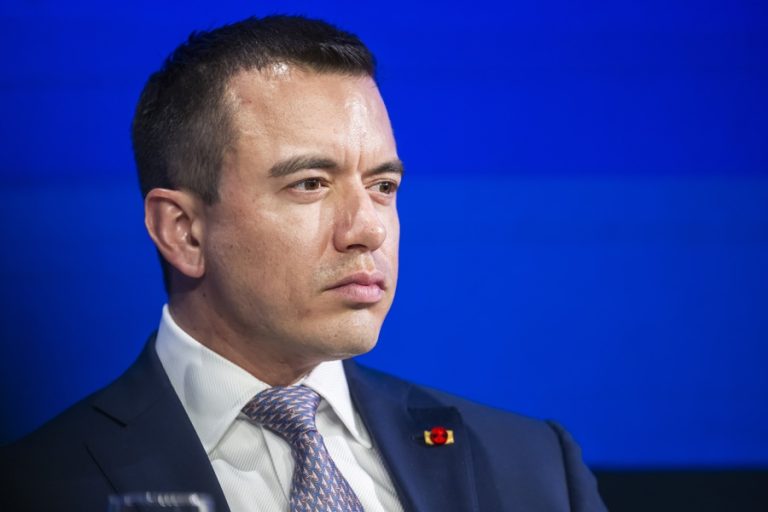
Ecuadorian President Daniel Noboa’s announcement on Wednesday about the imposition of 30% tariffs came as a surprise in Colombia, as it is the first time a border security and drug trafficking dispute has been used to impose customs tariffs.

“The example is spreading; previously, issues were resolved through diplomatic channels, through dialogue, consultation, and agreements, and now, for the past year, what prevails is the law of the jungle, the law of force,” Javier Díaz Molina, president of the National Foreign Trade Association (Analdex), told EFE referring to the tactics used by United States President Donald Trump.
As an argument for imposing 30% tariffs on Colombian products starting February 1, Noboa cited on Wednesday at the World Economic Forum in Davos, Switzerland, Colombia’s “lack of reciprocity and firm action” in the fight against drug trafficking.

“We have made real efforts to cooperate with Colombia, even with a trade deficit that exceeds 1 billion dollars annually. But while we have insisted on dialogue, our military continues to face criminal groups linked to drug trafficking on the border without any cooperation,” Noba wrote on his Twitter account on Wednesday.
The Colombian Foreign Ministry responded that “the continuous exchange of information (…) as well as the execution of operations between both countries (…) have allowed for significant operational results” with Ecuador, such as the seizure of 86,786 kilos of cocaine in 2023, a figure that rose to 132,354 kilos in 2024 and 195,862 kilos in 2025.

The Colombian Ministry of Foreign Affairs made “a strong call on the Ecuadorian government to desist from the aforementioned measure, thus preventing harmful impacts on our peoples.”
The ministry also expressed its “full willingness to address this situation through bilateral and constructive dialogue that will lead to an amicable resolution.”
However, before diplomatic channels were opened, Colombia’s Ministry of Commerce, Industry, and Tourism announced a 30% tariff on 20 products from Ecuador.

“The trade relationship between Colombia and Ecuador has been built on the basis of common rules and mutual cooperation. When that framework is modified unilaterally, and the previously existing trade conditions are affected, the Colombian State has an obligation to act to correct the alteration and protect its productive apparatus, guaranteeing the balance of trade,” said Minister Diana Marcela Morales.
Trade between Colombia and Ecuador, which share a 586-kilometer border, is worth nearly 2.7 billion dollars, with a surplus for Colombia of 920.7 million through November 2025, according to data updated Thursday by the National Administrative Department of Statistics (DANE).

Energy as a bargaining chip
In addition to reciprocal tariffs, Colombia suspended electricity sales to Ecuador, and the Ecuadorian government announced that it would modify the transportation tariff for Colombian oil extracted from southern fields and transported through the Heavy Crude Oil Pipeline (OCP).
Colombian electricity was essential in addressing the energy crisis that Ecuador has experienced in recent years, with blackouts of up to 14 hours a day.
“Last year, even in the midst of a severe drought, Colombia showed solidarity with Ecuador and guaranteed energy when its population faced blackouts of up to 14 hours. Today, in the face of arbitrary and unilateral decisions, we must act firmly to defend the dignity and sovereignty of our country,” said Colombian Minister of Mines and Energy Edwin Palma.
Palma set the suspension of the electrical interconnection for Thursday at 6:00 pm local time. EFE

joc/mcd
