

Cuba acknowledges “initial dialogue” with US
Havana, Mar 13 (EFE).- By Juan Palop
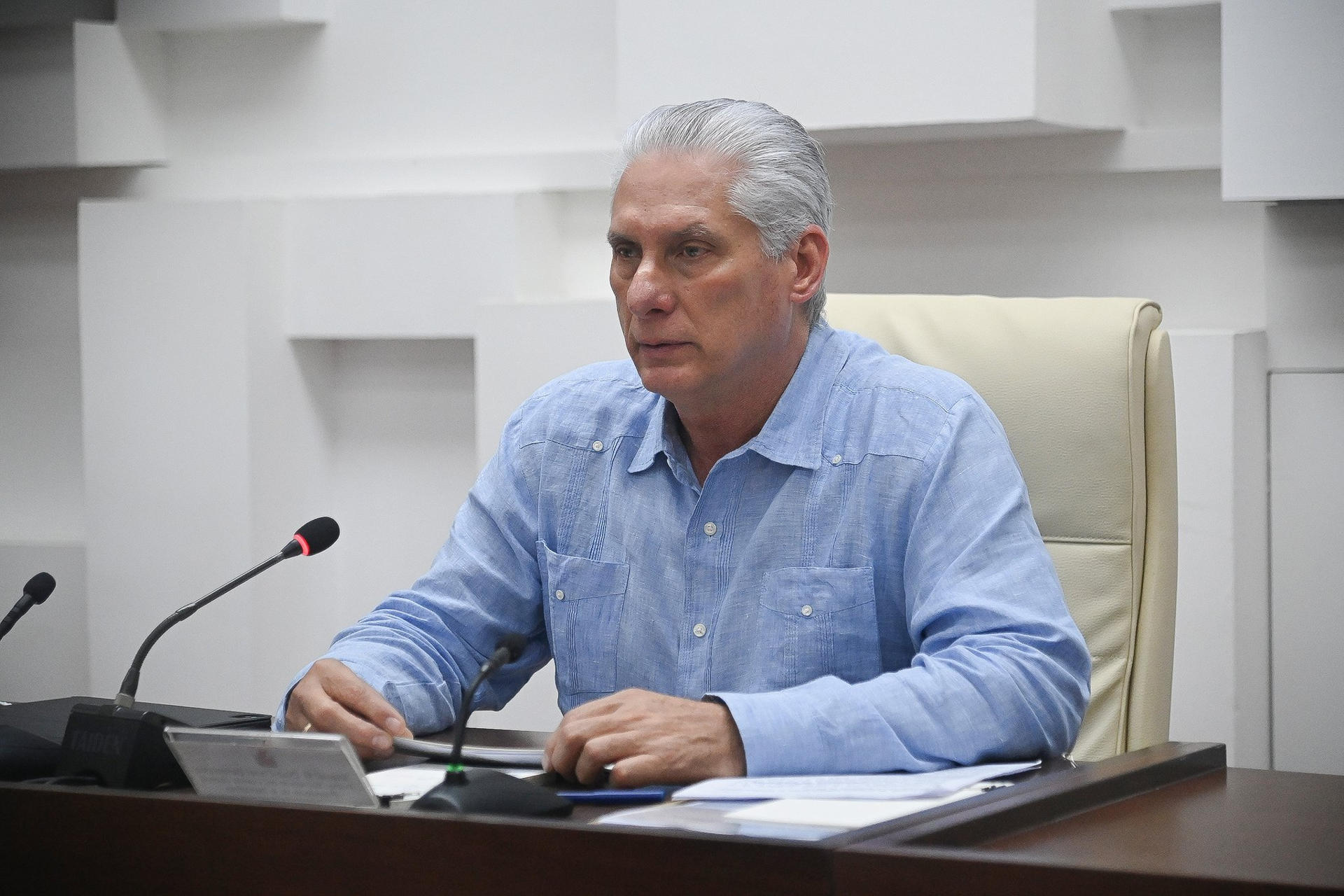
Cuban President Miguel Díaz-Canel acknowledged on Friday the existence of a “dialogue” with the United States, as Washington had been claiming for weeks, but indicated that it is in “initial stages” and that they are “far” from any agreement.
The announcement marked a turning point in the escalating tensions between both countries following the start of the US oil embargo against Cuba, which has brought the island to the brink of collapse, amid a severe economic, energy, and social crisis.

”Cuban officials recently held talks with representatives of the United States government to seek, through dialogue, a possible solution to the existing bilateral differences,” the president stated shortly after the release of a statement by the Communist Party of Cuba.
The objective, he added, is “to determine which bilateral problems need to be addressed,” to see “what the paths to solving those problems would be,” and, ultimately, “determine if there is a willingness on both sides to take concrete actions for the benefit of our people.”

He indicated that these talks involve a “fundamental effort to move forward with solutions,” as well as the “building of spaces for understanding” and “areas of cooperation” that will allow both countries to “advance in understanding and move away from confrontation.”
”This is a very sensitive process that is being approached with the discretion it requires at every stage, as well as with sensitivity, responsibility, and great seriousness,” he emphasized.
Díaz-Canel did not specify what topics might be on the agenda, nor the potential points that would involve compromises and concessions from both sides.

The president added that in these “exchanges,” the Cuban side has expressed “the willingness” for the talks to be held “on the basis of equality and respect for the political systems of both states, and for the sovereignty and self-determination” of both governments.
Díaz-Canel thanked the “international actors” who “facilitated” these contacts, although he did not explicitly name any of them.
The Mexican government had offered to mediate on several occasions, and on Thursday, it emerged that talks with the Vatican had led Havana to decide on the release of 51 prisoners.

In this regard, the NGO Prisoners Defenders indicated on Friday that it has confirmed at least five releases in recent hours. According to its records from the end of February, Cuba held a total of 1,214 political prisoners.
“Collegial” Decision
The president asserted that the decision to initiate these contacts with the US was made “collegially” among former president Raúl Castro, himself, and members of the government and the Communist Party of Cuba (PCC).
Raúl Guillermo Rodríguez Castro, Raúl Castro’s grandson, was present at the announcement. Although he holds no significant institutional position, several media outlets have identified him as the leader of the Cuban side in recent weeks’ initial contacts with the US.

Rodríguez, responsible for his grandfather’s personal security and apparently very close to the former president, had not participated in political events until Friday. His role had been limited to accompanying the former president, in a discreet second place, during his limited public activity.
Diaz-Canel also explained in his address that Cuban authorities are expecting a visit from agents of the US Federal Bureau of Investigation to collaborate in clarifying the incident involving the boat from the US in which five people died.

Cuba has described the Feb 25 boat incident as an “infiltration for terrorist purposes,” which could have become another source of political tension in the escalating conflict between Havana and Washington.
In recent months, the US has significantly increased pressure on Cuba by blocking oil imports to the island, which produces only a third of the crude oil it needs to meet its energy requirements.
US President Donald Trump had stated on several occasions in recent weeks that representatives of his administration were in contact with Cuban authorities and urged Havana to reach an agreement before it was too late.
The Cuban government repeatedly denied these talks, but ceased doing so in recent weeks. EFE

jpm-cdg/mcd