





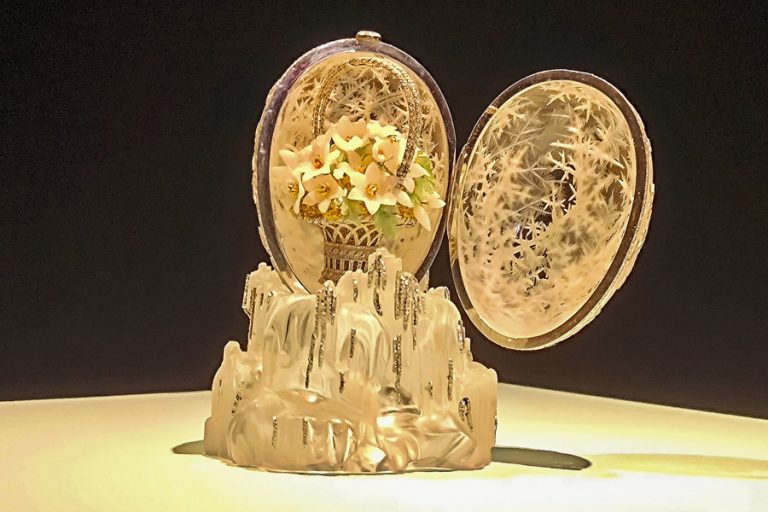
“Winter Egg” sold for a lot of money!
London, Dec 2 (EFE).-
Created by Russian jeweler Peter Carl Fabergé in 1913 for Tsar Nicholas II of Russia, the “Winter Egg” was sold on Tuesday at an auction in London for 22.89 million pounds, equivalent to 26 million euros.

The exquisite jewel was created by the jeweler for the Romanov dynasty and commissioned by the last Tsar of Russia, who was overthrown in 1918, as a gift for his mother, Dagmar of Denmark, and found a new owner on Tuesday after being auctioned off during “classic week” at Christie’s auction house.
The buyer’s name has not been disclosed, which is common at auctions, where buyers are often represented by intermediaries.
It is the third time that Christie’s has featured the sale of this “imperial egg.” Christie’s and Sotheby’s compete for global market leadership.

A work of extreme complexity
Carved from rock crystal, the egg and its base acquire a kind of translucent character. It is considered one of the most complex pieces the legendary jeweler ever created.
The crystal egg and its base are topped with platinum snowflakes set with rose-cut diamonds, Margo Oganesian, head of the Russian Works department at Christie’s, explained to EFE.
“Due to the complexity of the work and the manipulation of both materials, it is undoubtedly one of the most technically complex and difficult pieces that Fabergé ever created,” affirmed the expert.

“According to the jewel’s original description card, it has at least 4,500 diamonds,” stated Oganesian. This unimaginable figure makes the “Winter Egg” stand out among the other imperial Easter eggs.
The 15-centimeter-high egg opens to reveal a smaller platinum basket inside filled with white springtime flowers, rendered with delicate attention to detail.
“The symbolism is fundamental. The ‘Winter Egg’ symbolizes the arrival of spring after winter. It is a symbol of resurrection,” said Oganesian.

Designed by a woman
The egg’s design is attributed to Alma Pihl (1888-1976), a young woman who was one of the few female artisans in the Fabergé workshop. Only 50 eggs were created and sculpted by Fabergé.
During the reign of Nicholas II’s father, Alexander III (1885–1894), 10 of the 50 eggs were completed. Nicholas II continued the tradition, creating the remaining 40 eggs for his wife, Empress Alexandra Feodorovna, and for his mother.

After the Russian Revolution, the new Soviet government began selling treasures from the Hermitage and other national collections to Europe and the United States, including the personal belongings of the Romanovs, such as many of these eggs, due to the need for liquidity.
The “Winter Egg” ended up in the hands of the Warski jewelry store in London for 450 pounds (511 euros) in the late 1920s. It was passed from collector to collector, but its trail went cold in 1975.

The iconic jewel reappeared in 1994 when it was auctioned in Geneva, and set the first of its records: 7.77 million euros, which was surpassed eight years later in New York, where the egg was sold for 8.25 million euros, its highest value to date. EFE

ygg/dgp/mcd
